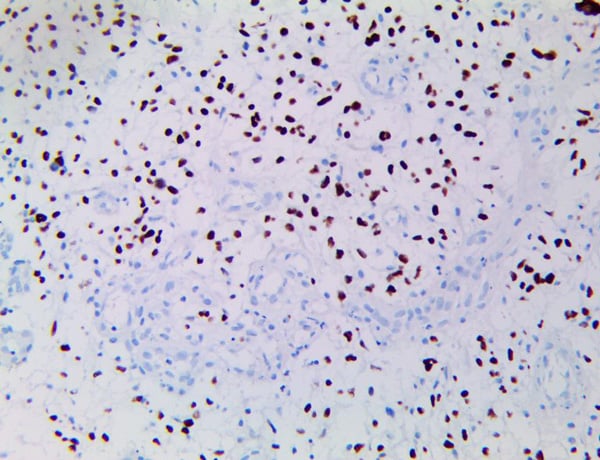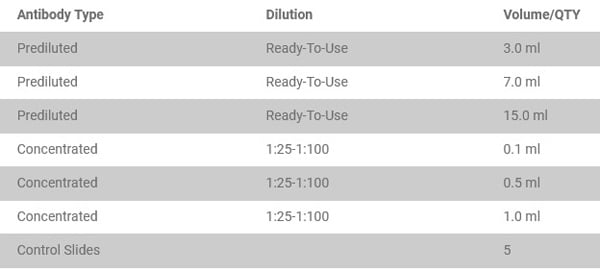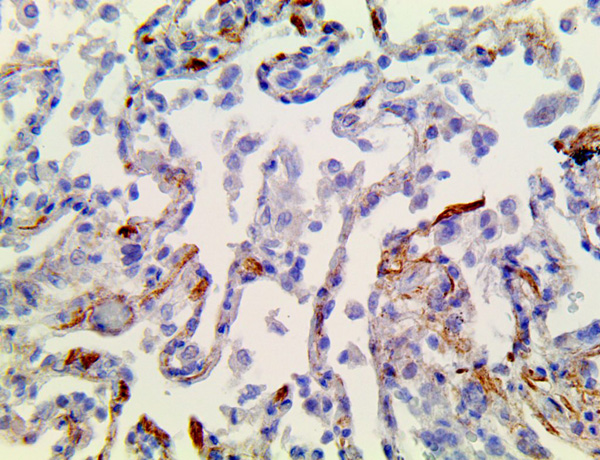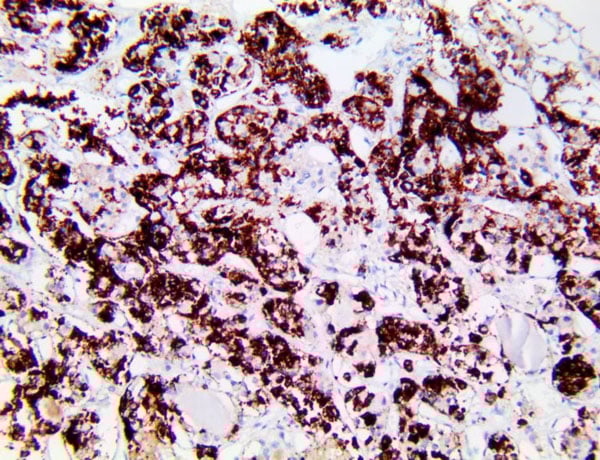
Get accurate results in your research with our Monoclonal Antibodies, which are specially made to target exactly what you require for your research, and will produce consistent, reliable performance in lab tests.
Application Data (Hela Cells were treated with BrdU for 3 hours and stained with Mouse anti BrdU antibody, clone Bu20a . Goat anti Mouse IgG (H/L) DyLight 549 conjugated antibody (red) was used as the secondary antibody. Cytoplasm was stained with Rabbit anti GAPDH antibody . As the secondary antibody, Sheep anti Rabbit IgG DyLight 488 conjugated antibody (green) was used. PureBlu DAPI (1351303) was used as nuclear counterstain (blue).)
Application Data (HeLa Cells were treated with 10 mug BrdU for 1 hour (B) or left untreated (A). Cells were stained with Mouse anti BrdU antibody, clone Bu20a at a dilution of 1/25. As a secondary antibody, Goat anti Mouse IgG (H/L) DyLight 549 conjugated antibody (red) was used at a 1/50 dilution. Cytoplasm was stained with Rabbit anti GAPDH antibody at a dilution of 1/100. As a secondary antibody, Sheep anti Rabbit IgG DyLight 488 conjugated antibody (green) was used at a 1/50 dilution. PureBlu DAPI (1351303) was used as nuclear counterstain.)
Application Data (Published Customer Image:Mouse Anti Bromodeoxyuridine antibody, clone Bu20a used to stain dividing crypt cells in rat small intestine by immunohistochemistry on formalin fixed, paraffin embedded tissue sections.Image caption:BrdU/ Bu20a/ Small intestine/ Rat.From: Furukawa S, Nagaike M, Ozaki K.Databases for technical aspects of immunohistochemistry.J Toxicol Pathol. 2017 Jan;30(1):79-107.)
Application Data (Published Customer image:Mouse anti Bromodeoxyuridine antibody, clone Bu20a used for the identification of proliferating cells in the rat dentate gyrus by immunofluorescence.Image caption:Ghrelin does not significantly inhibit the rate of stem cell self-renewal in the SGZ of the DG of adult rats. Representative images identifying triple positive (BrdU+/Sox2+/S100B+) new adult-born astrocytes (arrows) and double-positive (BrdU+/Sox2+/S100B-) new adult-born stem cells (arrowheads). Statistical analysis was performed using one-way ANOVA with Bonferroni's post hoc test, n = 12 rats per group. Scale bar = 20mum.From: Kent BA, Beynon AL, Hornsby AK, Bekinschtein P, Bussey TJ, Davies JS, Saksida LM.The orexigenic hormone acyl-ghrelin increases adult hippocampal neurogenesis and enhances pattern separation.Psychoneuroendocrinology. 2015 Jan;51:431-9.)
Application Data (Mouse anti Bromodeoxyuridine antibody, clone Bu20a used for the identification of proliferating cells in the rat dentate gyrus by immunofluorescence.Image caption:Ghrelin enhances spatial pattern separation and adult hippocampal neurogenesis in adult rats.(D) Representative images of DCX+ immature neurones and new adult-born DG neurones (white arrows) co-expressing NeuN+ and BrdU+ (yellow). Scale bar = 200mum.From: Kent BA, Beynon AL, Hornsby AK, Bekinschtein P, Bussey TJ, Davies JS, Saksida LM.The orexigenic hormone acyl-ghrelin increases adult hippocampal neurogenesis and enhances pattern separation.Psychoneuroendocrinology. 2015 Jan;51:431-9.)
Application Data (Mouse Anti Bromodeoxyuridine antibody, clone Bu20a used to label DNA synthesis in cultured mouse astrocytes by immunofluorescence.Image caption:Astrocyte response to injury involves proliferation which is attenuated by TTX and KB-R7943. (a) GFAP positive cultured rat cortical astrocytes (green) exhibit BrdU immunolabelling (red), seen in resting cells (top row) and scratched cells (second row). There is an increase in BrdU-positive cells along the edge of a scratch, which is attenuated with TTX and KB-R7943 treatment (third and fourth rows, respectively). Scale bar 200 mum. (b) After 24 h, there was a significant 77 +/- 9% increase in proliferation amongst cells along the edge of a wound (n=7) compared to cells in unscratched cultures (n=8), as measured by BrdU staining. Compared to untreated cells, TTX decreased proliferation by 54 +/- 4%, while KB-R7943 decreased proliferation by 46 +/- 9%. *p)
Application Data (Brdu-labeled human lymphoma cells were stained with Mouse anti BrdU antibody, clone BU20a, at a 1/100 dilution for 1 hour at room temperature. Goat anti Mouse IgG (H/L) DyLight 649 conjugated was used as the secondary detection reagent at a 1/50 dilution. PUREBLU Hoechst 33342 (1351304) was used to stain total DNA. B. BrdU-labeled human lymphoma cells were stained with Mouse anti BrdU antibody, clone BU20a, at a 1/100 dilution overnight at 4 degree C. Goat anti Mouse IgG (H/L) FITC conjugated antibody was used at a 1/50 dilution. READIDROP Propidium Iodide (1351101) was used to stain total DNA.)
FCM (Flow Cytometry) (Flow cytometry analysis of PD-L2 overexpressing HEK293 cells using PD-L2 antibody and control mouse IgG antibody at 10 μg/ml. Blue: Untransfected HEK293 cells. Yellow: PD-L2 overexpressing HEK293 cells.)
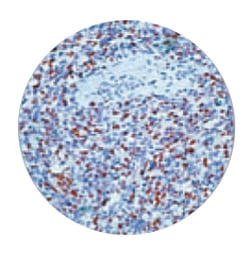
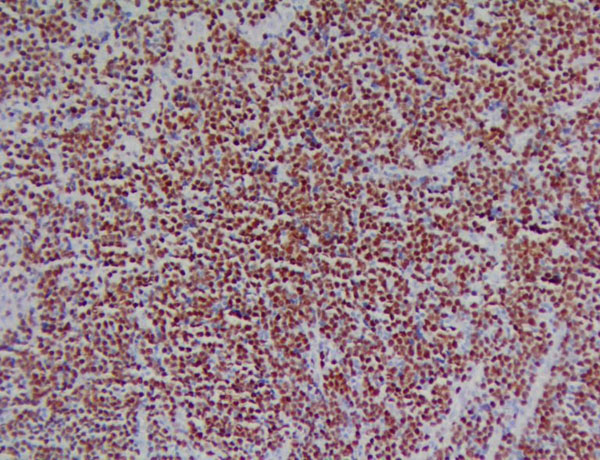
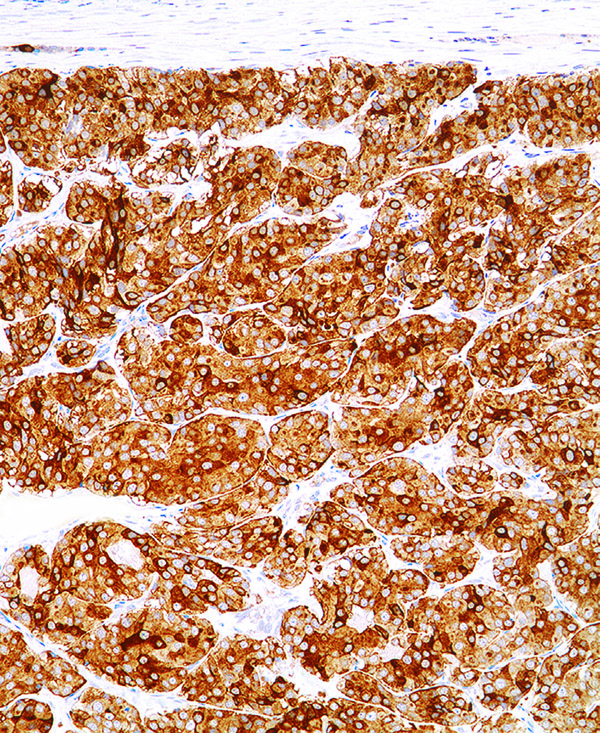
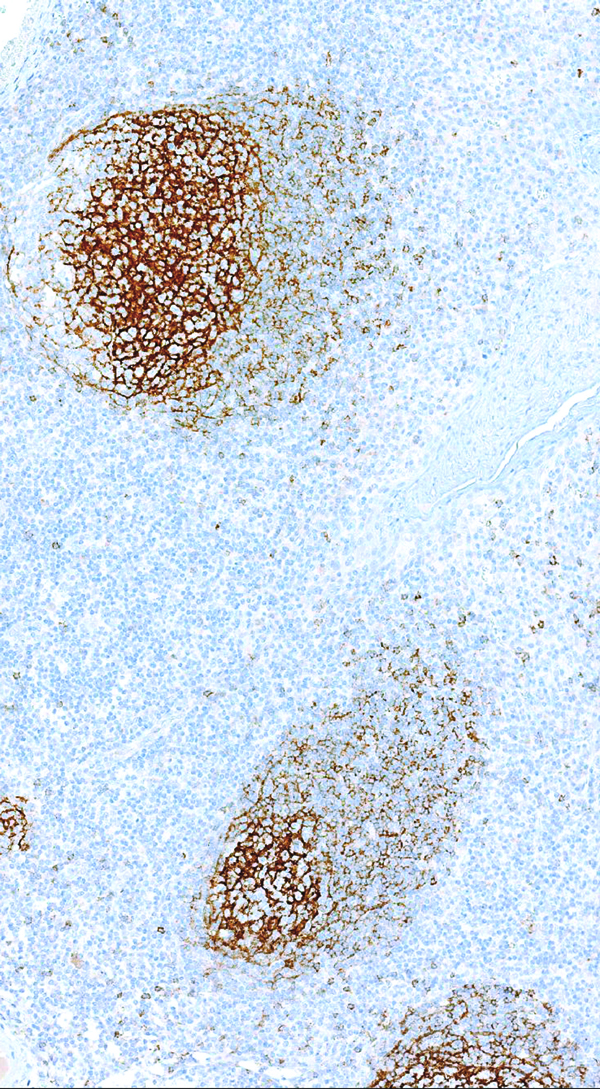
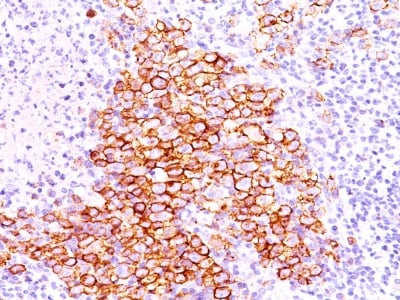
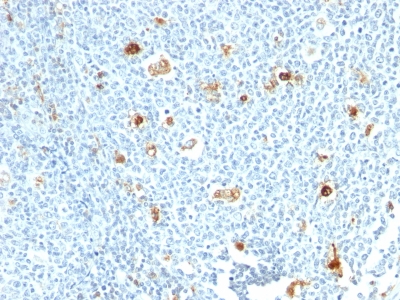
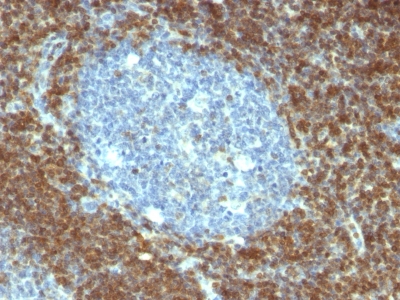
IHC (Immunohistchemistry) (Immunohistochemistry of PD-L2 in human tonsil tissue with PD-L2antibody at 2 ?g/mL.)
IF (Immunofluorescence) (Immunofluorescence of PD-L2 in human colon carcinoma tissue with PD-L2 antibody at 20 μg/mL.Green: PDL2 Antibody [7C7]Blue: DAPI staining)
IF (Immunofluorescence) (Immunofluorescence of PD-L2 in human tonsil tissue with PD-L2 antibody at 20 μg/mL.Green: PDL2 Antibody [7C7]Blue: DAPI staining)
IF (Immunofluorescence) (Immunofluorescence of PD-L2 in transfected HEK293 cells with PD-L2 antibody at 20 μg/mL.Green: PDL2 Antibody [7C7]Blue: DAPI staining)
ICC (Immunocytochemistry) (Immunocytochemistry of PD-L2 in transfected HEK293 cells with PD-L2 antibody at 5 μg/mL. Lower left: Immunocytochemistry in transfected HEK293 cells with control mouse IgG antibody at 5 μg/mL.)
FCM (Flow Cytometry) (Flow cytometric analysis of K562 cells with Leptin Receptor antibody at 1/100 dilution (red) compared with an unlabelled control (cells without incubation with primary antibody; black).)
ICC (Immunocytochemistry) (ICC staining Leptin Receptor in MCF-7 cells (green). The nuclear counter stain is DAPI (blue). Cells were fixed in paraformaldehyde, permeabilised with 0.25% Triton X100/PBS.)
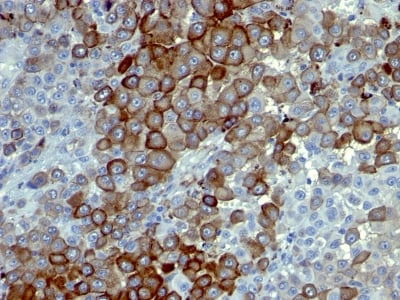
IHC (Immunohistochemistry) (Immunohistochemical analysis of paraffin-embedded human kidney tissue using anti-Leptin Receptor antibody. Counter stained with hematoxylin.)
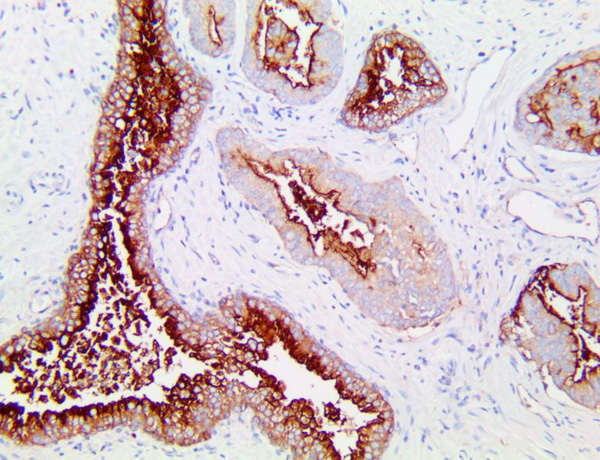
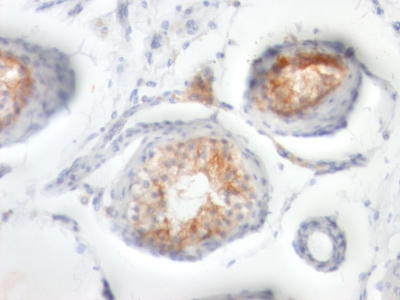
IHC (Immunohistochemistry) (Immunohistochemical analysis of paraffin-embedded human prostate tissue using anti-Leptin Receptor antibody. Counter stained with hematoxylin.)
IHC (Immunohistochemistry) (Immunohistochemical analysis of paraffin-embedded mouse small intestine tissue using anti-Leptin Receptor antibody. Counter stained with hematoxylin.)
IHC (Immunohistochemistry) (Immunohistochemical analysis of paraffin-embedded human liver cancer tissue using anti-Leptin Receptor antibody. Counter stained with hematoxylin.)
IHC (Immunohistochemistry) (Immunohistochemical analysis of paraffin-embedded rat heart tissue using anti-Leptin Receptor antibody. Counter stained with hematoxylin.)
FCM (Flow Cytometry) (Flow cytometric analysis of 293T cells with Creatine kinase B type antibody at 1/100 dilution (red) compared with an unlabelled control (cells without incubation with primary antibody; black). Alexa Fluor 488-conjugated goat anti rabbit IgG was used as the secondary antibody.)
ICC (Immunocytochemistry) (ICC staining Creatine kinase B type in LOVO cells (green). The nuclear counter stain is DAPI (blue). Cells were fixed in paraformaldehyde, permeabilised with 0.25% Triton X100/PBS.)
ICC (Immunocytochemistry) (ICC staining Creatine kinase B type in 293T cells (green). The nuclear counter stain is DAPI (blue). Cells were fixed in paraformaldehyde, permeabilised with 0.25% Triton X100/PBS.)
IHC (Immunohistochemistry) (Immunohistochemical analysis of paraffin-embedded mouse colon tissue using anti-Creatine kinase B type antibody. Counter stained with hematoxylin.)
IHC (Immunohistochemistry) (Immunohistochemical analysis of paraffin-embedded human prostate tissue using anti-Creatine kinase B type antibody. Counter stained with hematoxylin.)
IHC (Immunohistochemistry) (Immunohistochemical analysis of paraffin-embedded rat brain tissue using anti-Creatine kinase B type antibody. Counter stained with hematoxylin.)
WB (Western Blot) (Western blot analysis of Creatine kinase B type on different lysates using anti-Creatine kinase B type antibody at 1/500 dilution. Positive control: Lane 1: Mouse brain Lane 2: Mouse brain Lane 3: Rat brain Lane 4: 293)
FCM (Flow Cytometry) (Flow cytometric analysis of Jurkat cells with gamma Tubulin antibody at 1/50 dilution (red) compared with an unlabelled control (cells without incubation with primary antibody; black). Alexa Fluor 488-conjugated goat anti rabbit IgG was used as the secondary antibody.)
ICC (Immunocytochemistry) (ICC staining gamma Tubulin in SHG-44 cells (red). The nuclear counter stain is DAPI (blue). Cells were fixed in paraformaldehyde, permeabilised with 0.25% Triton X100/PBS.)
ICC (Immunocytochemistry) (ICC staining gamma Tubulin in MCF-7 cells (red). The nuclear counter stain is DAPI (blue). Cells were fixed in paraformaldehyde, permeabilised with 0.25% Triton X100/PBS.)
ICC (Immunocytochemistry) (ICC staining gamma Tubulin in Hela cells (red). The nuclear counter stain is DAPI (blue). Cells were fixed in paraformaldehyde, permeabilised with 0.25% Triton X100/PBS.)
IHC (Immunohistochemistry) (Immunohistochemical analysis of paraffin-embedded mouse testis tissue using anti-gamma Tubulin antibody. Counter stained with hematoxylin.)
IHC (Immunohistochemistry) (Immunohistochemical analysis of paraffin-embedded mouse colon tissue using anti-gamma Tubulin antibody. Counter stained with hematoxylin.)
WB (Western Blot) (Western blot analysis of gamma Tubulin on different lysates using anti-gamma Tubulin antibody at 1/1, 000 dilution. Positive control: Lane 1: A431 Lane 2: Jurkat Lane 3: Mouse brain)
Application Data (Published customer image: Increased accumulation of repair-associated macrophages surrounding collaterals in ischemic hind limbs is PAR2-dependent. (A) Stainings of CD206-positive macrophages (green) and SMA-positive vessels (red) in non-ischemic (control) and ischemic (ligated) hind limbs of WT, PAR1-/- and PAR2-/- mice are shown. Nuclei were visualized with DAPI (blue). Arrows indicate single macrophages in the non-ischemic adductor. Quantification of the average number of repair-associated macrophages per vessel is indicated on the right. (B) Correlation between the number of CD206-positive macrophages in the ischemic tissues and the expression of CD11b and (C) CD115 on monocytes. ** p)
Application Data (Published customer image: Western blot analysis to determine type of activation of adult primary microglial cells produced from wild-type and IL-1 KO mice stimulated with IL-4, IL-13 or IL-4/IL-13 with or without IL-1beta. (A) Representative western blotting data of primary microglial cells produced from wild-type (wild) and IL-1 KO mice and exposed for 24 hours to IL-4, IL-13 or IL-4 plus IL-13 (IL-4/IL-13) with or without IL-1beta. Each lane expected to CD206 blotting were applied 7 ug of reduced samples. Non-reduced samples (5 ug) were applied to detect CD206. Densitometric analysis of COX2 (B), Ym1 (C), Arg-1 (D) and CD206 (E) (n = 3 each group). (B) COX2 levels are increased by exposure of cells to IL-1beta and are not influenced by IL-4 or IL-13 alone. The COX2 level was slightly enhanced by IL-1beta and IL-4 co-treatment. (C) Ym1 levels are increased by exposure of cells to IL-4 and IL-4/Il-13 and are synergistically increased by co-treatment with IL-1beta. However, only a low level of Ym1 is seen upon exposure of cells to IL-13, and is significantly less than that seen in response to exposure of cells to IL-4. (D) Arg-1 shows similar levels in response to exposure to IL-4 and IL-4/IL-13; these are synergistically increased by co-treatment with IL-1beta. However, low levels of Arg-1 are seen for exposure of cells to IL-13. (G) CD206 was detected in response to exposure of cells to both IL-4 and IL-4/IL-13 with or without IL-1beta; however, CD206 levels in IL-13-exposed samples were lower than those seen with the other treatments. Data are expressed as mean +/- SD (n = 3). *: P < 0.05, **: P < 0.01, ***: P < 0.001 compared with the IL-4-treated group without IL-1beta for each genotype (one-way ANOVA followed by Dunnett post-hoc test). ANOVA, analysis of variance; arg-1, arginase 1; COX 2, cyclooxygenase 2.From: Sato A, Ohtaki H, Tsumuraya T, Song D, Ohara K, Asano M, Iwakura Y, Atsumi T, Shioda S. Interleukin-1 participates in the classical and alternative activation of microglia/macrophages after spinal cord injury. J Neuroinflammation. 2012 Apr 7;9:65.)
Application Data (Immunofluorescence staining of a mouse lymph node cryosection with Rat anti Mouse CD206 antibody, clone MR5D3 , green in A and Rat anti Mouse CD8 antibody, clone YTS105.18 , red in B. C is the merged image with nuclei counterstained in blue using DAPI. Low power)
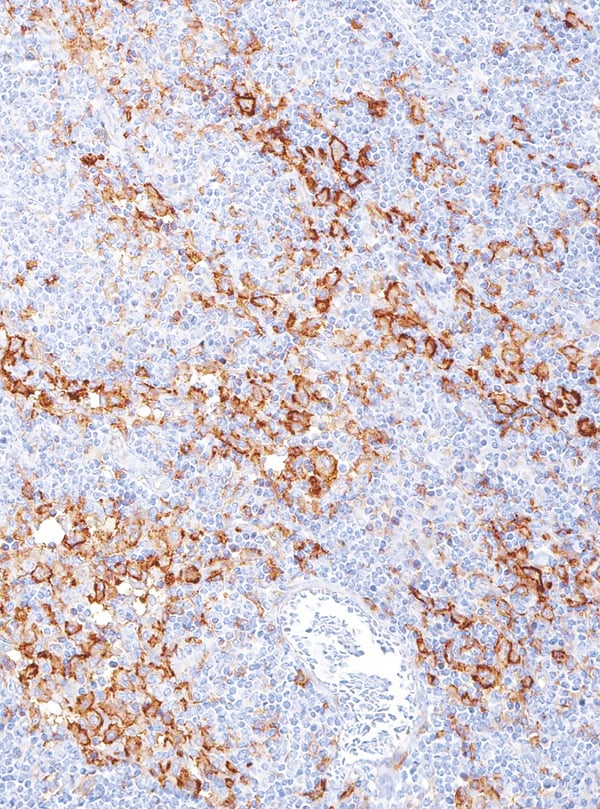
Application Data (Immunoperoxidase staining of a mouse lymph node cryosection with Rat anti Mouse CD206 antibody, clone MR5D3 followed by horseradish peroxidase conjugated Goat anti Rat IgG antibody . High power)
Application Data (Immunoperoxidase staining of a mouse lymph node cryosection with Rat anti Mouse CD206 antibody, clone MR5D3 followed by horseradish peroxidase conjugated Goat anti Rat IgG antibody . Low power)
Application Data (Staining of J774 cell line with Rat anti Mouse CD206 following permeabilisation with Leucoperm)
Application Data (Staining of mouse peritoneal macrophages with Rat anti Mouse CD206: Alexa Fluor 488)
Application Data (Immunofluorescence staining of a mouse lymph node cryosection with Rat anti Mouse CD206 antibody, clone MR5D3 , green in A and Rat anti Mouse CD8 antibody, clone YTS105.18 , red in B. C is the merged image with nuclei counterstained in blue using DAPI. High power)
Application Data (Immunoperoxidase staining of a mouse lymph node cryosection with Rat anti Mouse CD206 antibody, clone MR5D3 followed by horseradish peroxidase conjugated Goat anti Rat IgG antibody . Medium power)
Application Data (Staining of mouse peritoneal macrophages with Rat anti Mouse CD206: Alexa Fluor 647)
Application Data (Staining of J774 cells with Rat anti Mouse F4/80 antigen Biotin)
Application Data (Published customer image: Post-injury 7,8-dihydroxyflavone treatment increased brain BDNF levels and promoted CREB activation. (A) Bar graphs demonstrating brain derived neurotrophic factor (BDNF) protein concentrations measured by enzyme-linked immunosorbent assay (ELISA) in sham-injured, vehicle-treated, and 20 mg/kg 7,8-dihydroxyflavone (DHF 20)-treated mice at 4 days post-TBI. DHF 20 significantly increased BDNF protein levels in the ipsilateral hemisphere at 4 days post-injury. (B) Bar graphs demonstrating BDNF mRNA expression measured by real -time quantitative reverse transcriptase polymerase chain reaction (RT-PCR) at 1 and 4 days post-injury. DHF 20 significantly increased BDNF mRNA levels in the ipsilateral hemisphere at 4 days post-injury. (C) Western blot analysis of the phospho-CREB level in the ipsilateral hemisphere of sham-injured, vehicle-treated, and DHF 20-treated mice at 1 h, 1 day, and 4 days post-injury. DHF 20 enhanced CREB phosphorylation at 4 days post-injury. (D) Identification of phospho-CREB-positive cells 4 day post-injury in the peri-contusional margin by double immunofluorescence staining. Phospho-CREB is shown in red, and NeuN (neurons), GFAP (astrocytes), or F4/80 (microglia) is shown in green. Co-localization of phospho-CREB with NeuN is shown by yellow labeling. Sections were stained with DAPI (blue) to show all nuclei. Values are mean +/- SEM; *P)
Application Data (Staining of mouse peritoneal macrophages with Rat anti Mouse F4/80 antigen: Pacific Blue)
Application Data (Staining of J774 cells with Rat anti Mouse F4/80 antigen:Biotin)
Application Data (Frozen mouse spleen stained with A: Rat anti Mouse F4/80 followed by Goat anti Rat IgG:HRP or B: Rat anti Mouse F4/80 preincubated with 2 molar excess of Human anti Idiotypic (HCA154) followed by Goat anti Rat IgG:HRP)
Application Data (Staining of J774 cells with Rat anti Mouse F4/80 antigen:Low Endotoxin)
Application Data (Staining of mouse peritoneal macrophages with Rat anti Mouse F4/80 antigen: RPE - Alexa Fluor 750)
Application Data (Staining of mouse peritoneal macrophages cells with Rat anti Mouse F4/80 antigen:APC)
Application Data (Immunofluorescence image of mouse small intestine stained with Rat anti Mouse F4/80 , red and Rat anti Mouse CD45 , green; nuclei are stained with DAPI, blue. The image higlights macrophages within the lamina propria)
Application Data (Staining of mouse peritoneal macrophages with Rat anti Mouse F4/80 antigen:FITC)
WB (Western Blot) (Western blot analysis of POU4F3 over-expressed 293 cell line, cotransfected with POU4F3 Validated Chimera RNAi (Lane 2) or non-transfected control (Lane 1). Blot probed with POU4F3 monoclonal antibody. GAPDH (36.1kD) used as specificity and loading control.)
Application Data (Detection limit for recombinant GST tagged POU4F3 is ~0.1ng/ml as a capture antibody.)
IF (Immunofluorescence) (Immunofluorescence of monoclonal antibody to POU4F3 on HeLa cell. [antibody concentration 10ug/ml])
WB (Western Blot) (Western Blot analysis of POU4F3 expression in transfected 293T cell line by POU4F3 monoclonal antibody. Lane 1: POU4F3 transfected lysate (37.1kD). Lane 2: Non-transfected lysate.)
WB (Western Blot) (POU4F3 monoclonal antibody Western Blot analysis of POU4F3 expression in HeLa NE.)
WB (Western Blot) (Western Blot detection against Immunogen (35.75kD).)
IP (Immunoprecipitation) (Immunoprecipitating PD-L2 in Hela whole cell lysate Lane 1: Mouse control IgG instead of in Hela whole cell lysate. Lane 2: (2ul) + Hela whole cell lysate (500ug) Lane 3: Hela whole cell lysate (20ug) For western blotting, the blot was detected at 1:2000, and a HRP-conjugated Protein G antibody was used as the secondary antibody at 1:2000 )
FCM (Flow Cytometry) (Overlay histogram showing 293 cells transfected with PD-L2 stained with (red line). The cells were incubated in 10% normal goat serum to block non-specific protein-protein interactions followed by the antibody (2ug/1*106cells) for 1 h at 4 degree C. The secondary antibody used was R-PE-conjugated Goat Anti-Mouse IgG(H+L) at 1/100 dilution for 30min at 4 degree C. Isotype control antibody (green line) was mouse IgG2b (2ug/1*106cells) used under the same conditions. Acquisition of >10,000 events was performed.)
IF (Immunofluorescence) (Immunofluorescence staining of U251 cells at 1:100, counter-stained with DAPI. The cells were incubated with the antibody overnight at 4 degree C. Nuclear DNA was labeled in blue with DAPI. The secondary antibody was FITC-conjugated AffiniPure Goat Anti-Mouse IgG (H+L).)
IF (Immunofluorescence) (Immunofluorescence staining of Raji cells at 1:100, counter-stained with DAPI. The cells were incubated with the antibody overnight at 4 degree C. Nuclear DNA was labeled in blue with DAPI. The secondary antibody was FITC-conjugated AffiniPure Goat Anti-Mouse IgG (H+L).)
IF (Immunofluorescence) (Immunofluorescence staining of Hela cells at 1:100, counter-stained with DAPI. The cells were incubated with the antibody overnight at 4 degree C. Nuclear DNA was labeled in blue with DAPI. The secondary antibody was FITC-conjugated AffiniPure Goat Anti-Mouse IgG (H+L).)
IF (Immunofluorescence) (Immunofluorescence staining of HepG2 cells at 1:100, counter-stained with DAPI. The cells were incubated with the antibody overnight at 4 degree C. Nuclear DNA was labeled in blue with DAPI. The secondary antibody was FITC-conjugated AffiniPure Goat Anti-Mouse IgG (H+L).)
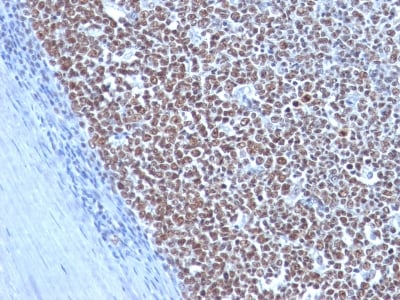
IHC (Immunohistochemistry) (IHC image diluted at 1:100 and staining in paraffin-embedded human tonsil tissue performed on a Leica BondTM system. After dewaxing and hydration, antigen retrieval was mediated by high pressure in a citrate buffer (pH 6.0). Section was blocked with 10% normal goat serum 30min at RT. Then primary antibody (1% BSA) was incubated at 4 degree C overnight. The primary is detected by a biotinylated secondary antibody and visualized using an HRP conjugated SP system.)
WB (Western Blot) (Western Blot Positive WB detected in: Hela whole cell lysate at 20ug, 10ug, 5ug, 2.5ug, 1.25ug All lanes: PD-L2 antibody at 1:2000 Secondary Goat polyclonal to mouse IgG at 1/50000 dilution Predicted band size: 31,21 KDa Observed band size: 45-50 KDa Exposure time?5min)
WB (Western Blot) (Western Blot Positive WB detected in: HepG2 whole cell lysate, Hela whole cell lysate, PC-3 whole cell lysate, A549 whole cell lysate All lanes PD-L2 antibody at 1:2000 Secondary Goat polyclonal to mouse IgG at 1/50000 dilution Predicted band size: 31,21 KDa Observed band size: 45-50 KDa Exposure time?5min)
IF (Immunofluorescence) (Immunofluorescence to CDKN1B on HeLa cell using 124808 (10ug/ml).)
Application Data (Proximity Ligation Analysis (PLA) of protein-protein interactions between AKT1 and CDKN1B HeLa cells were stained with AKT1 rabbit purified polyclonal (1:1200) and 124808 (1:50). Signals were detected by 30 Detection Kit 613 (red), and nuclei were counterstained with DAPI (blue). Each red dot represents the detection of protein-protein interaction complex.)
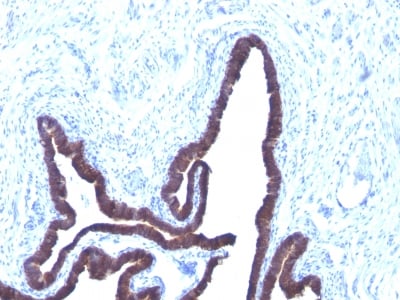
IHC (Immunohistochemistry) (Immunoperoxidase to CDKN1B on formalin-fixed paraffin-embedded human ovary, clear cell carcinoma tissue using 124808 (5ug/ml).)
WB (Western Blot) (Western Blot analysis of CDKN1B expression in transfected 293T cell line by 124808 Lane 1: CDKN1B transfected lysate (22.1kD). Lane 2: Non-transfected lysate.)
WB (Western Blot) (Western Blot detection against Immunogen (47.89kD).)
Application Data (Detection limit for 124808 is 10ng/ml as a capture antibody.)
ICC (Immunocytochemistry) (ICC staining Phospho-Glycogen synthase 1 (S641) in NIH/3T3 cells (green). The nuclear counter stain is DAPI (blue). Cells were fixed in paraformaldehyde, permeabilised with 0.25% Triton X100/PBS.)
ICC (Immunocytochemistry) (ICC staining Phospho-Glycogen synthase 1 (S641) in A549 cells (green). The nuclear counter stain is DAPI (blue). Cells were fixed in paraformaldehyde, permeabilised with 0.25% Triton X100/PBS.)
IHC (Immunohistochemistry) (Immunohistochemical analysis of paraffin-embedded mouse smooth muscle tissue using anti-Phospho-Glycogen synthase 1 (S641) antibody. Counter stained with hematoxylin.)
IHC (Immunohistochemistry) (Immunohistochemical analysis of paraffin-embedded mouse skeletal muscle tissue using anti-Phospho-Glycogen synthase 1 (S641) antibody. Counter stained with hematoxylin.)
IHC (Immunohistochemistry) (Immunohistochemical analysis of paraffin-embedded mouse liver tissue using anti-Phospho-Glycogen synthase 1 (S641) antibody. Counter stained with hematoxylin.)
WB (Western Blot) (Western blot analysis of Phospho-Glycogen synthase 1 (S641) on different lysates using anti-Phospho-Glycogen synthase 1 (S641) antibody at 1/1, 000 dilution. Positive control: Lane 1: Mouse liver lysate, untreated Lane 3: Mouse liver lysate, treated with AP)
FCM (Flow Cytometry) (Flow cytometric analysis of Jurkat cells with MCL1 antibody at 1/50 dilution (blue) compared with an unlabelled control (cells without incubation with primary antibody; red). Alexa Fluor 488-conjugated goat anti rabbit IgG was used as the secondary antibody.)
ICC (Immunocytochemistry) (ICC staining MCL1 in BT-20 cells (green). The nuclear counter stain is DAPI (blue). Cells were fixed in paraformaldehyde, permeabilised with 0.25% Triton X100/PBS.)
ICC (Immunocytochemistry) (ICC staining MCL1 in HepG2 cells (green). The nuclear counter stain is DAPI (blue). Cells were fixed in paraformaldehyde, permeabilised with 0.25% Triton X100/PBS.)
ICC (Immunocytochemistry) (ICC staining MCL1 in Hela cells (green). The nuclear counter stain is DAPI (blue). Cells were fixed in paraformaldehyde, permeabilised with 0.25% Triton X100/PBS.)
IHC (Immunohistochemistry) (Immunohistochemical analysis of paraffin-embedded human pancreas tissue using anti-MCL1 antibody. Counter stained with hematoxylin.)
IHC (Immunohistochemistry) (Immunohistochemical analysis of paraffin-embedded human kidney tissue using anti-MCL1 antibody. Counter stained with hematoxylin.)
IHC (Immunohistochemistry) (Immunohistochemical analysis of paraffin-embedded human breast tissue using anti-MCL1 antibody. Counter stained with hematoxylin.)
WB (Western Blot) (Western blot analysis of MCL1 on different lysates using anti-MCL1 antibody at 1/1, 000 dilution. Positive control: Lane 1: Raji Lane 2: Mouse heart)
IHC (Immunohistchemistry) (Immunohistochemistry analysis of paraffin-embedded Rat colon tissue using [KO Validated] Integrin alpha 2 (ITGA2/CD49b) Rabbit mAb (AAA28479) at a dilution of 1:500 (40x lens). High pressure antigen retrieval performed with 0.01M Tris-EDTA Buffer (pH 9.0) prior to IHC staining.)
IHC (Immunohistochemistry) (Immunohistochemistry analysis of paraffin-embedded Mouse spleen tissue using [KO Validated] Integrin alpha 2 (ITGA2/CD49b) Rabbit mAb (AAA28479) at a dilution of 1:500 (40x lens). High pressure antigen retrieval performed with 0.01M Tris-EDTA Buffer (pH 9.0) prior to IHC staining.)
IHC (Immunohistochemistry) (Immunohistochemistry analysis of paraffin-embedded Human kidney tissue using [KO Validated] Integrin alpha 2 (ITGA2/CD49b) Rabbit mAb (AAA28479) at a dilution of 1:500 (40x lens). High pressure antigen retrieval performed with 0.01M Tris-EDTA Buffer (pH 9.0) prior to IHC staining.)
IHC (Immunohistchemistry) (Immunohistochemistry analysis of paraffin-embedded Human esophagus tissue using [KO Validated] Integrin alpha 2 (ITGA2/CD49b) Rabbit mAb (AAA28479) at a dilution of 1:500 (40x lens). High pressure antigen retrieval performed with 0.01M Tris-EDTA Buffer (pH 9.0) prior to IHC staining.)
IHC (Immunohistochemistry) (Immunohistochemistry analysis of paraffin-embedded Human breast tissue using [KO Validated] Integrin alpha 2 (ITGA2/CD49b) Rabbit mAb (AAA28479) at a dilution of 1:500 (40x lens). High pressure antigen retrieval performed with 0.01M Tris-EDTA Buffer (pH 9.0) prior to IHC staining.)
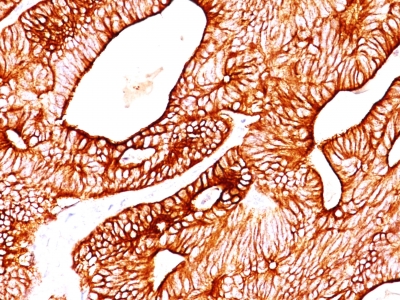
IHC (Immunohistochemistry) (Immunohistochemistry analysis of paraffin-embedded Human colon carcinoma tissue using [KO Validated] Integrin alpha 2 (ITGA2/CD49b) Rabbit mAb (AAA28479) at a dilution of 1:500 (40x lens). High pressure antigen retrieval performed with 0.01M Tris-EDTA Buffer (pH 9.0) prior to IHC staining.)
WB (Western Blot) (Western blot analysis of lysates from wild type(WT) and Integrin alpha 2 (ITGA2/CD49b) knockout (KO) 293T cells, using [KO Validated] Integrin alpha 2 (ITGA2/CD49b) Rabbit mAb (AAA28479) at 1:1000 dilution.Secondary antibody: HRP-conjugated Goat anti-Rabbit IgG (H+L) (AS014) at 1:10000 dilution.Lysates/proteins: 25ug per lane.Blocking buffer: 3% nonfat dry milk in TBST.Detection: ECL Basic Kit (RM00020).Exposure time: 1s.)
WB (Western Blot) (Western blot analysis of various lysates, using [KO Validated] Integrin alpha 2 (ITGA2/CD49b) Rabbit mAb (AAA28479) at 1:1000 dilution.Secondary antibody: HRP-conjugated Goat anti-Rabbit IgG (H+L) (AS014) at 1:10000 dilution.Lysates/proteins: 25ug per lane.Blocking buffer: 3% nonfat dry milk in TBST.Detection: ECL Basic Kit (RM00020).Exposure time: 10s.)
WB (Western Blot) (Western blot analysis of lysates from A549 cells, using [KO Validated] Integrin alpha 2 (ITGA2/CD49b) Rabbit mAb (AAA28479) at 1:1000 dilution.Secondary antibody: HRP-conjugated Goat anti-Rabbit IgG (H+L) (AS014) at 1:10000 dilution.Lysates/proteins: 25ug per lane.Blocking buffer: 3% nonfat dry milk in TBST.Detection: ECL Basic Kit (RM00020).Exposure time: 1s.)
FCM (Flow Cytometry) (Flow cytometric analysis of Hela cells with SMYD3 antibody at 1/100 dilution (red) compared with an unlabelled control (cells without incubation with primary antibody; black).)
ICC (Immunocytochemistry) (ICC staining SMYD3 in LOVO cells (green). The nuclear counter stain is DAPI (blue). Cells were fixed in paraformaldehyde, permeabilised with 0.25% Triton X100/PBS.)
ICC (Immunocytochemistry) (ICC staining SMYD3 in HepG2 cells (green). The nuclear counter stain is DAPI (blue). Cells were fixed in paraformaldehyde, permeabilised with 0.25% Triton X100/PBS.)
ICC (Immunocytochemistry) (ICC staining SMYD3 in Hela cells (green). The nuclear counter stain is DAPI (blue). Cells were fixed in paraformaldehyde, permeabilised with 0.25% Triton X100/PBS.)
IHC (Immunohistochemistry) (Immunohistochemical analysis of paraffin-embedded mouse stomach tissue using anti-SMYD3 antibody. Counter stained with hematoxylin.)
IHC (Immunohistochemistry) (Immunohistochemical analysis of paraffin-embedded human placenta tissue using anti-SMYD3 antibody. Counter stained with hematoxylin.)
IHC (Immunohistochemistry) (Immunohistochemical analysis of paraffin-embedded human colon cancer tissue using anti-SMYD3 antibody. Counter stained with hematoxylin.)
IHC (Immunohistochemistry) (Immunohistochemical analysis of paraffin-embedded human tonsil tissue using anti-SMYD3 antibody. Counter stained with hematoxylin.)
WB (Western Blot) (Western blot analysis of SMYD3 on different cell/tissue lysate using anti-Profilin 1 antibody at 1/1, 000 dilution. Positive control�� Lane1: Rat kidney Lane2: PC-12 Lane3: Hela Lane4: Mouse spleen Lane5: NIH-3T3 Lane6: Rat spleen)
FCM (Flow Cytometry) (Flow cytometric analysis of Hela cells with LOX antibody at 1/100 dilution (red) compared with an unlabelled control (cells without incubation with primary antibody; black). Alexa Fluor 488-conjugated goat anti rabbit IgG was used as the secondary antibody.)
ICC (Immunocytochemistry) (ICC staining LOX in SH-SY5Y cells (green). The nuclear counter stain is DAPI (blue). Cells were fixed in paraformaldehyde, permeabilised with 0.25% Triton X100/PBS.)
ICC (Immunocytochemistry) (ICC staining LOX in HUVEC cells (green). The nuclear counter stain is DAPI (blue). Cells were fixed in paraformaldehyde, permeabilised with 0.25% Triton X100/PBS.)
ICC (Immunocytochemistry) (ICC staining LOX in Hela cells (green). The nuclear counter stain is DAPI (blue). Cells were fixed in paraformaldehyde, permeabilised with 0.25% Triton X100/PBS.)
IHC (Immunohistchemistry) (Immunohistochemical analysis of paraffin-embedded mouse heart tissue using anti-LOX antibody. Counter stained with hematoxylin.)
IHC (Immunohistochemistry) (Immunohistochemical analysis of paraffin-embedded human placenta tissue using anti-LOX antibody. Counter stained with hematoxylin.)
IHC (Immunohistochemistry) (Immunohistochemical analysis of paraffin-embedded human kidney tissue using anti-LOX antibody. Counter stained with hematoxylin.)
IHC (Immunohistochemistry) (Immunohistochemical analysis of paraffin-embedded rat skeletal muscle tissue using anti-LOX antibody. Counter stained with hematoxylin.)
WB (Western Blot) (Western blot analysis of LOX on Zebrafish tissue lysates using anti-LOX antibody at 1/1, 000 dilution.)
WB (Western Blot) (Western blot analysis of LOX on different lysates using anti-LOX antibody at 1/1, 000 dilution. Positive control: Lane 1: Jurkat Lane 2: Mouse brain Lane 3: Human fetal brain)
ICC (Immunocytochemistry) (ICC staining Nuclear Matrix Protein p84 in LOVO cells (green). The nuclear counter stain is DAPI (blue). Cells were fixed in paraformaldehyde, permeabilised with 0.25% Triton X100/PBS.)
ICC (Immunocytochemistry) (ICC staining Nuclear Matrix Protein p84 in HUVEC cells (green). The nuclear counter stain is DAPI (blue). Cells were fixed in paraformaldehyde, permeabilised with 0.25% Triton X100/PBS.)
IHC (Immunohistchemistry) (Immunohistochemical analysis of paraffin-embedded human lung cancer tissue using anti-Nuclear Matrix Protein p84 antibody. Counter stained with hematoxylin.)
IHC (Immunohistochemistry) (Immunohistochemical analysis of paraffin-embedded human tonsil tissue using anti-Nuclear Matrix Protein p84 antibody. Counter stained with hematoxylin.)
IHC (Immunohistochemistry) (Immunohistochemical analysis of paraffin-embedded human colon cancer tissue using anti-Nuclear Matrix Protein p84 antibody. Counter stained with hematoxylin.)
IHC (Immunohistochemistry) (Immunohistochemical analysis of paraffin-embedded rat brain tissue using anti-Nuclear Matrix Protein p84 antibody. Counter stained with hematoxylin.)
IHC (Immunohistochemistry) (Immunohistochemical analysis of paraffin-embedded rat testis tissue using anti-Nuclear Matrix Protein p84 antibody. Counter stained with hematoxylin.)
WB (Western Blot) (Western blot analysis of Nuclear Matrix Protein p84 on different lysates using anti-Nuclear Matrix Protein p84 antibody at 1/500 dilution. Positive control: Lane 1: Hela Lane 2: A431 Lane 3: Mouse skeletal muscle Lane 4: PC-12)
ICC (Immunocytochemistry) (ICC staining TGF alpha in PC-3M cells (green). The nuclear counter stain is DAPI (blue). Cells were fixed in paraformaldehyde, permeabilised with 0.25% Triton X100/PBS.)
ICC (Immunocytochemistry) (ICC staining TGF alpha in A549 cells (green). The nuclear counter stain is DAPI (blue). Cells were fixed in paraformaldehyde, permeabilised with 0.25% Triton X100/PBS.)
ICC (Immunocytochemistry) (ICC staining TGF alpha in A431 cells (green). The nuclear counter stain is DAPI (blue). Cells were fixed in paraformaldehyde, permeabilised with 0.25% Triton X100/PBS.)
IHC (Immunohistochemistry) (Immunohistochemical analysis of paraffin-embedded human colon cancer tissue using anti-TGF alpha antibody. Counter stained with hematoxylin.)
IHC (Immunohistochemistry) (Immunohistochemical analysis of paraffin-embedded human liver tissue using anti-TGF alpha antibody. Counter stained with hematoxylin.)
IHC (Immunohistochemistry) (Immunohistochemical analysis of paraffin-embedded human tonsil tissue using anti-TGF alpha antibody. Counter stained with hematoxylin.)
IHC (Immunohistochemistry) (Immunohistochemical analysis of paraffin-embedded human kidney tissue using anti-TGF alpha antibody. Counter stained with hematoxylin.)
IF (Immunofluorescence) (Immunofluorescence analysis of Mouse-liver tissue. 1.Caspase-8 Monoclonal Antibody(2G12)(red) was diluted at 1:200(4 degree C.overnight). 2. Cy3 labled Secondary antibody was diluted at 1:300(room temperature. 50min).3. Picture B: DAPI(blue) 10min. Picture A:Target. Picture B: DAPI. Picture C: merge of A+B)
IF (Immunofluorescence) (Immunofluorescence analysis of Hela cell. 1.ER? Polyclonal Antibody(red) was diluted at 1:200(4 degree overnight). Caspase-8 Monoclonal Antibody(2G12)(green) was diluted at 1:200(4 degree overnight). 2. Goat Anti Rabbit Alexa Fluor 594 was diluted at 1:1000(room temperature. 50min). Goat Anti Mouse Alexa Fluor 488 was diluted at 1:1000(room temperature. 50min).)
IHC (Immunohistochemistry) (Immunohistochemical analysis of paraffin-embedded Mouse-brain tissue. 1.Caspase-8 Monoclonal Antibody(2G12) was diluted at 1:200(4 degree C.overnight). 2. Sodium citrate pH 6.0 was used for antibody retrieval(>98 degree C.20min). 3.Secondary antibody was diluted at 1:200(room temperature. 30min). Negative control was used by secondary antibody only.)
IHC (Immunohistochemistry) (Immunohistochemical analysis of paraffin-embedded Mouse Spleen Tissue using Caspase-8 Monoclonal Antibody.)
IHC (Immunohistochemistry) (Immunohistochemical analysis of paraffin-embedded Human-Tonsil tissue. 1.Caspase-8 Monoclonal Antibody(2G12) was diluted at 1:200(4 degree C.overnight). 2. Sodium citrate pH 6.0 was used for antibody retrieval(>98 degree C.20min). 3.Secondary antibody was diluted at 1:200(room temperature. 30min). Negative control was used by secondary antibody only.)
WB (Western Blot) (Western blot analysis of 1) Hela. 2) Mouse Brain Tissue. 3) Rat Brain Tissue using Caspase-8 Monoclonal Antibody.)
Application Data (Detection limit for recombinant GST tagged SP1 is ~0.1ng/ml as a capture antibody.)
IF (Immunofluorescence) (Immunofluorescence of monoclonal antibody to SP1 on HeLa cell. [antibody concentration 10ug/ml].)
IHC (Immunohistochemistry) (Immunoperoxidase of monoclonal antibody to SP1 on formalin-fixed paraffin-embedded human colon. [antibody concentration 1ug/ml].)
IHC (Immunohistochemistry) (Immunoperoxidase of monoclonal antibody to SP1 on formalin-fixed paraffin-embedded human endometrium. [antibody concentration 1ug/ml].)
WB (Western Blot) (SP1 monoclonal antibody. Western Blot analysis of SP1 expression in NIH/3T3.)
WB (Western Blot) (SP1 monoclonal antibody, Western Blot analysis of SP1 expression in Hela NE.)
WB (Western Blot) (Western Blot detection against Immunogen (38.21kD).)
WB (Western Blot) (LETM1 monoclonal antibody Western Blot analysis of LETM1 expression in HeLa.)
WB (Western Blot) (Western Blot detection against Immunogen (37.62kD).)
Application Data (Detection limit for recombinant GST tagged LETM1 is ~0.03ng/ml as a capture antibody.)
IP (Immunoprecipitation) (Immunoprecipitation of LETM1 transfected lysate using LETM1 monoclonal antibody and Protein A Magnetic Bead, and immunoblotted with LETM1 rabbit polyclonal antibody.)
IF (Immunofluorescence) (Immunofluorescence of monoclonal antibody to LETM1 on HeLa cell. [antibody concentration 10ug/ml])
IHC (Immunohistochemistry) (Immunoperoxidase of monoclonal antibody to LETM1 on formalin-fixed paraffin-embedded human small Intestine. [antibody concentration 3ug/ml])
WB (Western Blot) (Western Blot analysis of LETM1 expression in transfected 293T cell line by LETM1 monoclonal antibody. Lane 1: LETM1 transfected lysate (83.4kD). Lane 2: Non-transfected lysate.)
WB (Western Blot) (DARS monoclonal antibody Western Blot analysis of DARS expression in HeLa.)
WB (Western Blot) (Western blot analysis of DARS over-expressed 293 cell line, cotransfected with DARS Validated Chimera RNAi (Lane 2) or non-transfected control (Lane 1). Blot probed with DARS monoclonal antibody. GAPDH (36.1kD) used as specificity and loading control.)
Application Data (Detection limit for recombinant GST tagged DARS is ~0.3ng/ml as a capture antibody.)
IHC (Immunohistochemistry) (Immunoperoxidase of monoclonal antibody to DARS on formalin-fixed paraffin-embedded human colon. [antibody concentration 3ug/ml].)
WB (Western Blot) (Western Blot analysis of DARS expression in transfected 293T cell line by DARS monoclonal antibody. Lane 1: DARS transfected lysate (57.1kD). Lane 2: Non-transfected lysate.)
WB (Western Blot) (Western Blot detection against Immunogen (37.62kD).)
WB (Western Blot) (Western blot analysis of ILK over-expressed 293 cell line, cotransfected with ILK Validated Chimera RNAi (Lane 2) or non-transfected control (Lane 1). Blot probed with ILK monoclonal antibody. GAPDH (36.1kD) used as specificity and loading control.)
WB (Western Blot) (ILK monoclonal antibody. Western Blot analysis of ILK expression in NIH/3T3.)
Application Data (Detection limit for recombinant GST tagged ILK is ~3ng/ml as a capture antibody.)
WB (Western Blot) (ILK monoclonal antibody. Western Blot analysis of ILK expression in HepG2.)
WB (Western Blot) (ILK monoclonal antibody. Western Blot analysis of ILK expression in PC-12.)
WB (Western Blot) (ILK monoclonal antibody Western Blot analysis of ILK expression in HeLa.)
WB (Western Blot) (Western Blot detection against Immunogen (38.06kD).)
Application Data (Detection limit for recombinant GST tagged TAF11 is approximately 0.1ng/ml as a capture antibody.)
WB (Western Blot) (TAF11 monoclonal antibody (M04), clone 2G9 Western Blot analysis of TAF11 expression in Hela S3 NE.)
IF (Immunofluorescence) (Immunofluorescence of monoclonal antibody to TAF11 on HeLa cell. [antibody concentration 10 ug/ml])
IHC (Immunohistochemistry) (Immunoperoxidase of monoclonal antibody to TAF11 on formalin-fixed paraffin-embedded human placenta. [antibody concentration 3 ug/ml])
Application Data (Immunoperoxidase of monoclonal antibody to TAF11 on formalin-fixed paraffin-embedded human placenta. [antibody concentration 3 ug/ml])
FCM (Flow Cytometry) (Flow cytometric analysis of Hela cells with Filamin A antibody at 1/50 dilution (blue) compared with an unlabelled control (cells without incubation with primary antibody; red). Alexa Fluor 488-conjugated goat anti-rabbit IgG was used as the secondary antibody.)
ICC (Immunocytochemistry) (ICC staining Filamin A in HUVEC cells (green). Cells were fixed in paraformaldehyde, permeabilised with 0.25% Triton X100/PBS.)
ICC (Immunocytochemistry) (ICC staining Filamin A in Ags cells (green). The nuclear counter stain is DAPI (blue). Cells were fixed in paraformaldehyde, permeabilised with 0.25% Triton X100/PBS.)
ICC (Immunocytochemistry) (ICC staining Filamin A in Hela cells (green). The nuclear counter stain is DAPI (blue). Cells were fixed in paraformaldehyde, permeabilised with 0.25% Triton X100/PBS.)
IHC (Immunohistochemistry) (Immunohistochemical analysis of paraffin-embedded mouse uterus tissue using anti-Filamin A antibody. Counter stained with hematoxylin.)
IHC (Immunohistochemistry) (Immunohistochemical analysis of paraffin-embedded human uterus tissue using anti-Filamin A antibody. Counter stained with hematoxylin.)
WB (Western Blot) (Western blot analysis of Filamin A on different cell lysates using anti-Filamin A antibody at 1/1, 000 dilution. Positive control: Lane 1: MCF-7 Lane 2: Jurkat Lane 3: Hela Lane 4: NIH/3T3)
WB (Western Blot) (Western Blot detection against Immunogen (78.03kD).)
WB (Western Blot) (POLK monoclonal antibody, Western Blot analysis of POLK expression in Hela NE.)
Application Data (Detection limit for recombinant GST tagged POLK is ~0.3ng/ml as a capture antibody.)
IF (Immunofluorescence) (Immunofluorescence of monoclonal antibody to POLK on HeLa cell. [antibody concentration 10ug/ml].)
IHC (Immunohistochemistry) (Immunoperoxidase of monoclonal antibody to POLK on formalin-fixed paraffin-embedded human stomach. [antibody concentration 3ug/ml].)
WB (Western Blot) (Western Blot analysis of POLK expression in transfected 293T cell line by POLK monoclonal antibody. Lane 1: POLK transfected lysate (54.1kD). Lane 2: Non-transfected lysate.)
WB (Western Blot) (Western blot analysis of POLK over-expressed 293 cell line, cotransfected with POLK Validated Chimera RNAi (Lane 2) or non-transfected control (Lane 1). Blot probed with POLK monoclonal antibody. GAPDH (36.1kD) used as specificity and loading control.)
ICC (Immunocytochemistry) (Confocal imaging of NIH/3T3 cells using Calreticulin Mouse mAb (AAA28600, dilution 1:200) followed by a further incubation with Cy3 Goat Anti-Mouse IgG (H+L) (AS008, dilution 1:500) (Red). DAPI was used for nuclear staining (Blue). Objective: 100x.)
IHC (Immunohistchemistry) (Immunohistochemistry analysis of paraffin-embedded Rat brain tissue using Calreticulin Mouse mAb (AAA28600) at a dilution of 1:200 (40x lens). High pressure antigen retrieval performed with 0.01M Citrate Buffer (pH 6.0) prior to IHC staining.)
IHC (Immunohistochemistry) (Immunohistochemistry analysis of paraffin-embedded Mouse brain tissue using Calreticulin Mouse mAb (AAA28600) at a dilution of 1:200 (40x lens). High pressure antigen retrieval performed with 0.01M Citrate Buffer (pH 6.0) prior to IHC staining.)
IHC (Immunohistochemistry) (Immunohistochemistry analysis of paraffin-embedded Human breast cancer tissue using Calreticulin Mouse mAb (AAA28600) at a dilution of 1:200 (40x lens). High pressure antigen retrieval performed with 0.01M Citrate Buffer (pH 6.0) prior to IHC staining.)
IHC (Immunohistochemistry) (Immunohistochemistry analysis of paraffin-embedded Human brain tissue using Calreticulin Mouse mAb (AAA28600) at a dilution of 1:200 (40x lens). High pressure antigen retrieval performed with 0.01M Citrate Buffer (pH 6.0) prior to IHC staining.)
WB (Western Blot) (Western blot analysis of lysates from C6 cells using Calreticulin Mouse mAb (AAA28600) at 1:5000 dilution incubated overnight at 4?.Secondary antibody: HRP-conjugated Goat anti-Mouse IgG (H+L) (AS003) at 1:10000 dilution.Lysates/proteins: 25 ug per lane.Blocking buffer: 3% nonfat dry milk in TBST.Detection: ECL Basic Kit (RM00020).Exposure time: 90s.)
WB (Western Blot) (Western blot analysis of various lysates using Calreticulin Mouse mAb (AAA28600) at 1:5000 dilution incubated overnight at 4?.Secondary antibody: HRP-conjugated Goat anti-Mouse IgG (H+L) (AS003) at 1:10000 dilution.Lysates/proteins: 25 ug per lane.Blocking buffer: 3% nonfat dry milk in TBST.Detection: ECL Basic Kit (RM00020).Exposure time: 60s.)
Application Data (Immunoperoxidase staining of rat lymph node cryosection with Mouse anti Rat CD86 antibody, clone 42F followed by horseradish peroxidase conjugated Goat anti Mouse IgG . Low power)
Application Data (Immunoperoxidase staining of rat lymph node cryosection with Mouse anti Rat CD86 antibody, clone 42F followed by horseradish peroxidase conjugated Goat anti Mouse IgG . Medium power)
Application Data (Staining of rat splenocytes with Mouse anti Rat CD86:RPE)
Application Data (Staining of rat splenocytes with Mouse anti Rat CD86:Alexa Fluor ?647)
Application Data (Staining of rat splenocytes with Mouse anti Rat CD86:Low Endotoxin)
Application Data (Staining of rat splenocytes with Mouse anti Rat CD86:FITC)
Application Data (Staining of rat splenocytes with Mouse anti Rat CD86:Alexa Fluor ?488)
Application Data (Immunoperoxidase staining of rat lymph node cryosection with Mouse anti Rat CD86 antibody, clone 42F followed by horseradish peroxidase conjugated Goat anti Mouse IgG . High power)
FCM (Flow Cytometry) (Flow cytometric analysis of untreated Jurkat cells, using AAA14693 (blue) compared to a nonspecific negative control antibody (red).)
IHC (Immunohistchemistry) (Immunohistochemical analysis of paraffin-embedded HeLa cells untreated (left) or transfected (right), using AAA14693 (top) or Cleaved Caspase-3 (Asp175) (bottom). Note the induction of cleaved caspase-3 in Akt deficient cells.)
IHC (Immunohistochemistry) (Immunohistochemical analysis using AAA14693)
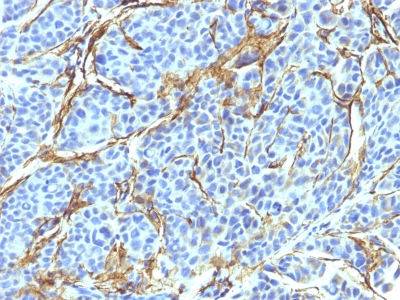
IHC (Immunohistochemistry) (Immunohistochemical analysis of paraffin-embedded human melanoma, using AAA14693.)
IHC (Immunohistochemistry) (Immunohistochemical analysis of paraffin-embedded human lung carcinoma, using AAA14693.)
IHC (Immunohistochemistry) (Immunohistochemical analysis of paraffin-embedded human breast carcinoma using AAA14693 in the presence of control peptide (left) or Akt (pan) Blocking Peptide (right).)
WB (Western Blot) (Western blot analysis of recombinant Akt1, Akt2 and Akt3 proteins, and extracts from HeLa, C2C12, C6 and COS cells, using AAA14693.)
WB (Western Blot) (Western blot analysis of TCF19 over-expressed 293 cell line, cotransfected with TCF19 Validated Chimera RNAi (Lane 2) or non-transfected control (Lane 1). Blot probed with TCF19 monoclonal antibody. GAPDH (36.1kD) used as specificity and loading control.)
Application Data (Detection limit for recombinant GST tagged TCF19 is ~0.1ng/ml as a capture antibody.)
IF (Immunofluorescence) (Immunofluorescence of monoclonal antibody to TCF19 on HeLa cell. [antibody concentration 10ug/ml])
IHC (Immunohistochemistry) (Immunoperoxidase of monoclonal antibody to TCF19 on formalin-fixed paraffin-embedded human testis. [antibody concentration 3ug/ml])
WB (Western Blot) (Western Blot analysis of TCF19 expression in transfected 293T cell line by TCF19 monoclonal antibody. Lane 1: TCF19 transfected lysate (37.2kD). Lane 2: Non-transfected lysate.)
WB (Western Blot) (TCF19 monoclonal antibody Western Blot analysis of TCF19 expression in Hela NE.)
WB (Western Blot) (Western blot analysis of TAF7 over-expressed 293 cell line, cotransfected with TAF7 Validated Chimera RNAi (Lane 2) or non-transfected control (Lane 1). Blot probed with TAF7 monoclonal antibody. GAPDH (36.1kD) used as specificity and loading control.)
Application Data (Detection limit for recombinant GST tagged TAF7 is ~0.3ng/ml as a capture antibody.)
IF (Immunofluorescence) (Immunofluorescence of monoclonal antibody to TAF7 on HeLa cell. [antibody concentration 10ug/ml])
IHC (Immunohistochemistry) (Immunoperoxidase of monoclonal antibody to TAF7 on formalin-fixed paraffin-embedded human placenta. [antibody concentration 1ug/ml])
IHC (Immunohistochemistry) (Immunoperoxidase of monoclonal antibody to TAF7 on formalin-fixed paraffin-embedded human lymph node. [antibody concentration 3ug/ml])
WB (Western Blot) (Western Blot analysis of TAF7 expression in transfected 293T cell line by TAF7 monoclonal antibody. Lane 1: TAF7 transfected lysate (40.3kD). Lane 2: Non-transfected lysate.)
WB (Western Blot) (TAF7 monoclonal antibody, Western Blot analysis of TAF7 expression in MCF-7.)
SDS-PAGE (SW480 whole cell lysates were separated by 10% SDS-PAGE, and the membrane was blotted with anti-CK8(ABT538) antibody. The HRP-conjugated Goat anti-M)
SDS-PAGE (Various whole cell lysates were separated by 8% SDS-PAGE, and the membrane was blotted with anti-N-Cadherin(ABT-CDH2) antibody. The HRP-conjugated Goat anti-M)
WB (Western Blot) (Western blot analysis of N-CadherinAntibody at 1:1000 dilution.)
FCM (Flow Cytometry) (Flow cytometry analysis of PD-L1 overexpressing HEK293 cells using PD-L1 antibody and control mouse IgG antibody at 10 μg/ml. Blue: Untransfected HEK293 cells. Yellow: PD-L1 overexpressing HEK293 cells.)
IHC (Immunohistochemistry) (Immunohistochemistry of PD-L1 in human tonsil tissue with PD-L1 antibody at 5 μg/mL.)
IHC (Immunohistchemistry) (Immunohistochemistry of PD-L1 in human stomach carcinoma tissue with PD-L1 antibody at 5 μg/mL.)
IF (Immunofluorescence) (Immunofluorescence of PD-L1 in human tonsil tissue with PD-L1 antibody at 2 μg/mL.Red: PDL1 Antibody [4F2]Blue: DAPI staining)
IF (Immunofluorescence) (Immunofluorescence of PD-L1 in human stomach carcinoma tissue with PD-L1 antibody at 2 μg/mL.Red: PDL1 Antibody [4F2]Blue: DAPI staining)
IF (Immunofluorescence) (Immunofluorescence of PD-L1 in transfected HEK293 cells with PD-L1 antibody at 2 μg/mL.Red: PDL1 Antibody [4F2]Blue: DAPI staining)
ICC (Immunocytochemistry) (Immunocytochemistry of PD-L1 in transfected HEK293 cells with PD-L1 antibody at 1 μg/mL. Lower left: Immunocytochemistry in transfected HEK293 cells with control mouse IgG antibody at 1 μg/mL.)
WB (Western Blot) (Western blot analysis of PD-L1 in overexpressing HEK293 cells PD-L1 antibody at 0.25 and 0.5 μg/ml)
Application Data (Frozen mouse spleen stained with Rat anti Mouse CD169)
Application Data (Immunofluorescence staining of mouse lymph node cryosection with Rat anti Mouse CD169 antibody clone 3D6.112 , green in A and Rat anti Mouse CD8 antibody, clone YTS105.18 , red in B. C is the merged image with nuclei counterstained blue using DAPI. High power)
Application Data (Mouse peritoneal macrophages stained with Rat anti Mouse CD169:FITC)
Application Data (Immunoperoxidase staining of Mouse lymph node cryosection stained with Rat anti Mouse CD169 antibody, clone 3D6.112 followed by Goat anti Rat IgG antibody as a detection reagent. Medium power)
Application Data (Immunoperoxidase staining of Mouse lymph node cryosection stained with Rat anti Mouse CD169 antibody, clone 3D6.112 followed by Goat anti Rat IgG antibody as a detection reagent. High power)
Application Data (Immunoperoxidase staining of Mouse lymph node cryosection stained with Rat anti Mouse CD169 antibody, clone 3D6.112 followed by Goat anti Rat IgG antibody as a detection reagent. Low power)
Application Data (Immunofluorescence staining of mouse lymph node cryosection with Rat anti Mouse CD169 antibody clone 3D6.112 , green in A and Rat anti Mouse CD8 antibody, clone YTS105.18 , red in B. C is the merged image with nuclei counterstained blue using DAPI. Low power)
WB (Western Blot) (Western blot analysis of IRAK1 over-expressed 293 cell line, cotransfected with IRAK1 Validated Chimera RNAi ((Lane 2) or non-transfected control (Lane 1). Blot probed with IRAK1 monoclonal antibody. GAPDH (36.1kD) used as specificity and loading control.)
Application Data (Detection limit for recombinant GST tagged IRAK1 is ~0.03ng/ml as a capture antibody.)
IP (Immunoprecipitation) (Immunoprecipitation of IRAK1 transfected lysate using IRAK1 monoclonal antibody and Protein A Magnetic Bead, and immunoblotted with IRAK1 rabbit polyclonal antibody.)
IF (Immunofluorescence) (Immunofluorescence of monoclonal antibody to IRAK1 on HeLa cell. [antibody concentration 10ug/ml])
IHC (Immunohistochemistry) (Immunoperoxidase of monoclonal antibody to IRAK1 on formalin-fixed paraffin-embedded human lung. [antibody concentration 3ug/ml])
WB (Western Blot) (Western Blot detection against Immunogen (43.45kD).)
WB (Western Blot) (RRAS2 monoclonal antibody Western Blot analysis of RRAS2 expression in A-431.)
WB (Western Blot) (RRAS2 monoclonal antibody Western Blot analysis of RRAS2 expression in NIH/3T3)
IF (Immunofluorescence) (Immunofluorescence of monoclonal antibody to RRAS2 on A-431 cell. [antibody concentration 10ug/ml])
IHC (Immunohistochemistry) (Immunoperoxidase of monoclonal antibody to RRAS2 on formalin-fixed paraffin-embedded human dysgerminoma tissue. [antibody concentration 5ug/ml])
WB (Western Blot) (Western Blot analysis of RRAS2 expression in transfected 293T cell line by RRAS2 monoclonal antibody Lane 1: RRAS2 transfected lysate (Predicted MW: 23.4kD. Lane 2: Non-transfected lysate.)
WB (Western Blot) (RRAS2 monoclonal antibody Western Blot analysis of RRAS2 expression in HeLa.)
WB (Western Blot) (Western Blot detection against Immunogen (48.55kD).)
CD28 (CD28 Antigen, CD28 Molecule, MGC138290, T cell Antigen CD28, T cell Specific Surface Glycoprotein, T cell Specific Surface Glycoprotein CD28, Tp44) (HRP)
FCM (Flow Cytometry) (Flow cytometric analysis of SH-SY5Y cells with C12orf51 antibody at 1/100 dilution (red) compared with an unlabelled control (cells without incubation with primary antibody; black).)
ICC (Immunocytochemistry) (ICC staining C12orf51 (green) in PC-3M cells. The nuclear counter stain is DAPI (blue). Cells were fixed in paraformaldehyde, permeabilised with 0.25% Triton X100/PBS.)
ICC (Immunocytochemistry) (ICC staining C12orf51 (green) in HepG2 cells. The nuclear counter stain is DAPI (blue). Cells were fixed in paraformaldehyde, permeabilised with 0.25% Triton X100/PBS.)
IHC (Immunohistochemistry) (Immunohistochemical analysis of paraffin-embedded mouse testis tissue using anti-C12orf51 antibody. Counter stained with hematoxylin.)
IHC (Immunohistochemistry) (Immunohistochemical analysis of paraffin-embedded human kidney tissue using anti-C12orf51 antibody. Counter stained with hematoxylin.)
IHC (Immunohistochemistry) (Immunohistochemical analysis of paraffin-embedded human colon cancer tissue using anti-C12orf51 antibody. Counter stained with hematoxylin.)
WB (Western Blot) (Western blot analysis of C12orf51 on SH-SY5Y (1) and A549 (2) using anti-C12orf51 antibody at 1/100 dilution.)
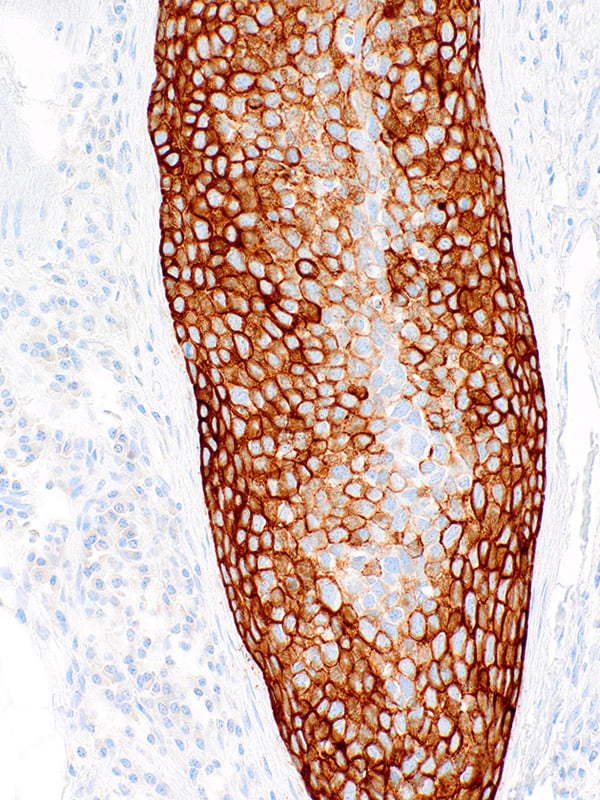
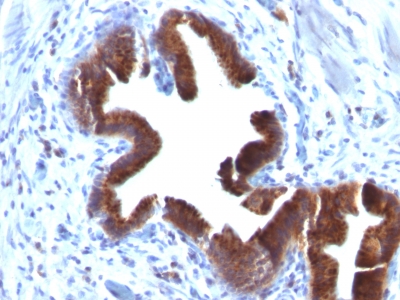
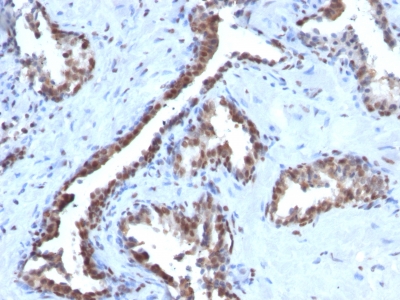
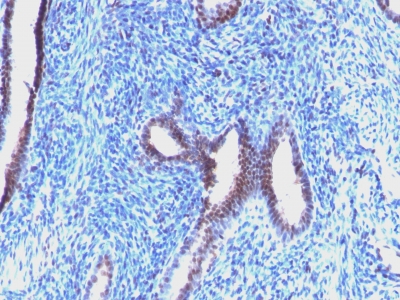
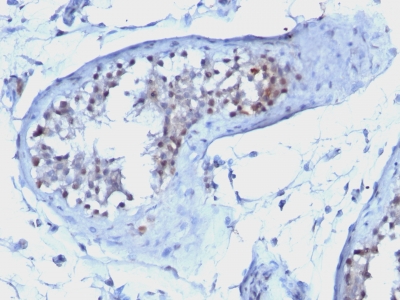
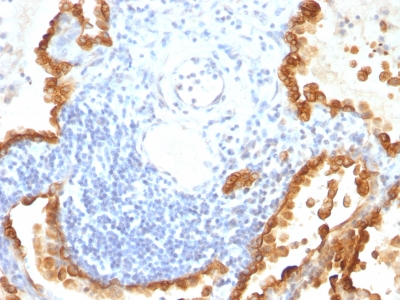
IHC (Immunohistchemistry) (Human tonsil tissue was stained with anti-Beta-catenin(ABT-Catenin) antibody.)
IHC (Immunohistochemistry) (Human prostate tissue was stained with anti-Beta-catenin(ABT-Catenin) antibody.)
IHC (Immunohistochemistry) (Human liver tissue was stained with anti-Beta-catenin(ABT-Catenin) antibody.)
IHC (Immmunohistochemistry) (Human colon carcinoma tissue was stained with anti-Beta-catenin(ABT-Catenin) antibody.)
IHC (Immunohistochemistry) (Human appendix tissue was stained with anti-Beta-catenin(ABT-Catenin) antibody.)
SDS-PAGE (Various whole cell lysates were separated by 10% SDS-PAGE, and the membrane was blotted with anti-Beta-catenin antibody. The HRP-conjugated anti-Mouse IgG antibody was used to detect the antibody.)
FCM (Flow Cytometry) (Flow cytometric analysis of Daudi cells with p150 CAF1 antibody at 1/100 dilution (purple) compared with an unlabelled control (cells without incubation with primary antibody; yellow). Alexa Fluor 488-conjugated goat anti-rabbit IgG was used as the secondary antibody.)
ICC (Immunocytochemistry) (ICC staining p150 CAF1 in LOVO cells (green). The nuclear counter stain is DAPI (blue). Cells were fixed in paraformaldehyde, permeabilised with 0.25% Triton X100/PBS.)
ICC (Immunocytochemistry) (ICC staining p150 CAF1 in A431 cells (green). The nuclear counter stain is DAPI (blue). Cells were fixed in paraformaldehyde, permeabilised with 0.25% Triton X100/PBS.)
ICC (Immunocytochemistry) (ICC staining p150 CAF1 in 293T cells (green). The nuclear counter stain is DAPI (blue). Cells were fixed in paraformaldehyde, permeabilised with 0.25% Triton X100/PBS.)
IHC (Immunohistochemistry) (Immunohistochemical analysis of paraffin-embedded human colon tissue using anti-p150 CAF1 antibody. Counter stained with hematoxylin.)
IHC (Immunohistochemistry) (Immunohistochemical analysis of paraffin-embedded human tonsil tissue using anti-p150 CAF1 antibody. Counter stained with hematoxylin.)
WB (Western Blot) (Western blot analysis of p150 CAF1 on K562 (1) and A431 (2) cell lysate using anti-p150 CAF1 antibody at 1/1, 000 dilution.)
FCM (Flow Cytometry) (Flow cytometric analysis of A431 cells with ITGA2 antibody at 1/50 dilution (red) compared with an unlabelled control (cells without incubation with primary antibody; black). Alexa Fluor 488-conjugated goat anti rabbit IgG was used as the secondary antibody.)
ICC (Immunocytochemistry) (ICC staining ITGA2 in MCF-7 cells (green). The nuclear counter stain is DAPI (blue). Cells were fixed in paraformaldehyde, permeabilised with 0.25% Triton X100/PBS.)
ICC (Immunocytochemistry) (ICC staining ITGA2 in A431 cells (green). The nuclear counter stain is DAPI (blue). Cells were fixed in paraformaldehyde, permeabilised with 0.25% Triton X100/PBS.)
IHC (Immunohistchemistry) (Immunohistochemical analysis of paraffin-embedded mouse stomach tissue using anti-ITGA2 antibody. Counter stained with hematoxylin.)
IHC (Immunohistochemistry) (Immunohistochemical analysis of paraffin-embedded mouse colon tissue using anti-ITGA2 antibody. Counter stained with hematoxylin.)
IHC (Immunohistochemistry) (Immunohistochemical analysis of paraffin-embedded human kidney tissue using anti-ITGA2 antibody. Counter stained with hematoxylin.)
IHC (Immunohistochemistry) (Immunohistochemical analysis of paraffin-embedded human breast carcinoma tissue using anti-ITGA2 antibody. Counter stained with hematoxylin.)
IHC (Immunohistochemistry) (Immunohistochemical analysis of paraffin-embedded human colon cancer tissue using anti-ITGA2 antibody. Counter stained with hematoxylin.)
WB (Western Blot) (Western blot analysis of ITGA2 on A431 cells lysates using anti-ITGA2 antibody at 1/1, 000 dilution.)
Application Data (Figure A. StarBright Blue 810 conjugated Mouse anti Human CD4 and Alexa Fluor 647 conjugated Mouse IgG2a isotype control. Figure B. StarBright Blue 810 conjugated Mouse anti Human CD4 and Alexa Fluor 647 conjugated Mouse anti Human CD3. All experiments performed on red cell lysed human blood gated on single cell lymphocytes, in the presence of 10% human serum. Data acquired on the ZE5 Cell Analyzer.)
Application Data (Figure A. StarBright Violet 570 conjugated Mouse anti Human CD4 and Alexa Fluor 488 conjugated Mouse IgG2a isotype control. Figure B. StarBright Violet 570 conjugated Mouse anti Human CD4 and Alexa Fluor 488 conjugated Mouse anti Human CD3. All experiments performed on red cell lysed human blood gated on single cell lymphocytes, in the presence of 10% human serum. Data acquired on the ZE5 Cell Analyzer.)
Application Data (Figure A. StarBright Violet 710 conjugated Mouse anti Human CD4 and Pacific Blue conjugated Mouse IgG2a isotype control . Figure B. StarBright Violet 710 conjugated Mouse anti Human CD4 and Pacific Blue conjugated Mouse anti Human CD3 . All experiments performed on red cell lysed human blood gated on live single cell lymphocytes, in the presence of 10% human serum. Data acquired on the ZE5 Cell Analyzer.)
Application Data (Figure A. StarBright Blue 580 conjugated Mouse anti Human CD4 and Alexa Fluor 700 conjugated Mouse IgG2a isotype control . Figure B. StarBright Blue 580 conjugated Mouse anti Human CD4 and Alexa Fluor 700 conjugated Mouse anti Human CD3 . All experiments performed on red cell lysed human blood gated on live single cell lymphocytes, in the presence of 10% human serum. Data acquired on the ZE5 Cell Analyzer.)
Application Data (Figure A. Alexa Fluor 488 conjugated Mouse anti Human CD4 and PE conjugated Mouse IgG2a isotype control . Figure B. Alexa Fluor 488 conjugated Mouse anti Human CD4 and PE conjugated Mouse anti Human CD3 . All experiments performed on red cell lysed human blood gated on live single cell lymphocytes, in the presence of 10% human serum. Data acquired on the ZE5 Cell Analyzer.)
Application Data (Figure A. StarBright Violet 790 conjugated Mouse anti Human CD4 and FITC conjugated Mouse IgG2a isotype control . Figure B. StarBright Violet 790 conjugated Mouse anti Human CD4 and FITC conjugated Mouse anti Human CD3 . All experiments performed on red cell lysed human blood gated on live single cell lymphocytes, in the presence of 10% human serum. Data acquired on the ZE5 Cell Analyzer.)
Application Data (Staining of J774 cells with Rat anti Mouse F4/80 antigen Biotin)
Application Data (Published customer image: Post-injury 7,8-dihydroxyflavone treatment increased brain BDNF levels and promoted CREB activation. (A) Bar graphs demonstrating brain derived neurotrophic factor (BDNF) protein concentrations measured by enzyme-linked immunosorbent assay (ELISA) in sham-injured, vehicle-treated, and 20 mg/kg 7,8-dihydroxyflavone (DHF 20)-treated mice at 4 days post-TBI. DHF 20 significantly increased BDNF protein levels in the ipsilateral hemisphere at 4 days post-injury. (B) Bar graphs demonstrating BDNF mRNA expression measured by real -time quantitative reverse transcriptase polymerase chain reaction (RT-PCR) at 1 and 4 days post-injury. DHF 20 significantly increased BDNF mRNA levels in the ipsilateral hemisphere at 4 days post-injury. (C) Western blot analysis of the phospho-CREB level in the ipsilateral hemisphere of sham-injured, vehicle-treated, and DHF 20-treated mice at 1 h, 1 day, and 4 days post-injury. DHF 20 enhanced CREB phosphorylation at 4 days post-injury. (D) Identification of phospho-CREB-positive cells 4 day post-injury in the peri-contusional margin by double immunofluorescence staining. Phospho-CREB is shown in red, and NeuN (neurons), GFAP (astrocytes), or F4/80 (microglia) is shown in green. Co-localization of phospho-CREB with NeuN is shown by yellow labeling. Sections were stained with DAPI (blue) to show all nuclei. Values are mean +/- SEM; *P)
Application Data (Staining of mouse peritoneal macrophages with Rat anti Mouse F4/80 antigen: Pacific Blue)
Application Data (Staining of J774 cells with Rat anti Mouse F4/80 antigen:Biotin)
Application Data (Frozen mouse spleen stained with A: Rat anti Mouse F4/80 followed by Goat anti Rat IgG:HRP or B: Rat anti Mouse F4/80 preincubated with 2 molar excess of Human anti Idiotypic (HCA154) followed by Goat anti Rat IgG:HRP)
Application Data (Staining of J774 cells with Rat anti Mouse F4/80 antigen:Low Endotoxin)
Application Data (Staining of mouse peritoneal macrophages with Rat anti Mouse F4/80 antigen: RPE - Alexa Fluor 750)
Application Data (Staining of mouse peritoneal macrophages cells with Rat anti Mouse F4/80 antigen:APC)
Application Data (Immunofluorescence image of mouse small intestine stained with Rat anti Mouse F4/80 , red and Rat anti Mouse CD45 , green; nuclei are stained with DAPI, blue. The image higlights macrophages within the lamina propria)
Application Data (Staining of mouse peritoneal macrophages with Rat anti Mouse F4/80 antigen:FITC)
Monoclonal antibodies are specialized laboratory-produced proteins developed for binding to specific biological antigens or other molecular targets. Since they come from a single cell (or clone), they are especially consistent and accurate in the data they are involved in producing.
This type of antibody material has been shown to be a powerful tool in finding and subsequently destroying harmful cells in an organism, such as those found in cancers or various autoimmune diseases. This makes them excellent aids in medical testing and research, which is why they are so widely used.
AAA Biotech offers a comprehensive range of high-quality monoclonal antibodies that perform effectively in various laboratory tests, including (amongst others) ELISA, western blotting, immunohistochemistry, and flow cytometry. All of the products in our catalog are thoroughly quality tested to make sure that they are reliable and will consistently perform well in your research.
What Are The Uses of Monoclonal Antibodies
Monoclonal antibodies are used in many lab tests, including (amongst others) ELISA, western blotting, immunohistochemistry, and flow cytometry.
ELISA is a test that helps detect a specific substance/analyte in a sample. It uses antibodies (often monoclonal) bound to a solid surface (such as the well of a microplate) to “capture” the substance/analyte in the sample and immobilize it so that the detection antibody component can then bind to it and produce a signal, which can then be measured.
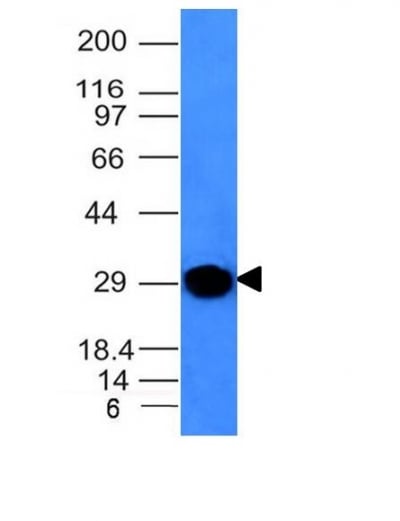
Western blotting identifies specific proteins in a sample. The sample is first separated on a gel, and then antibodies are applied that will typically bind to the target, which will all be localized to a single band in a lane.
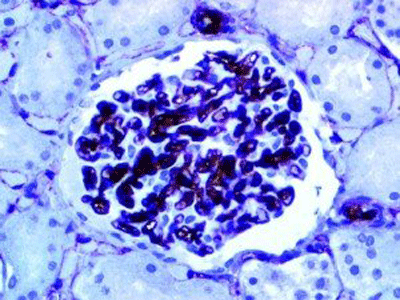
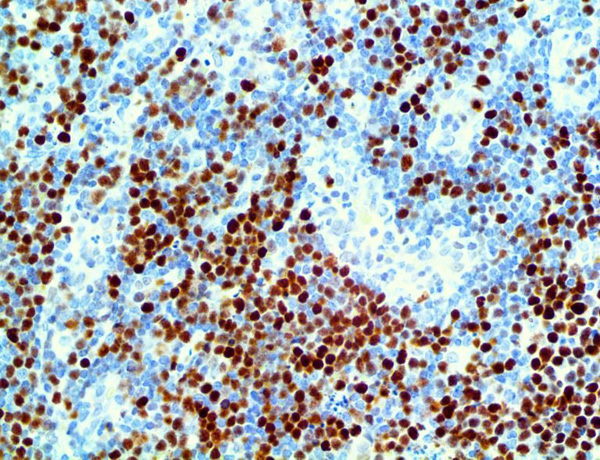
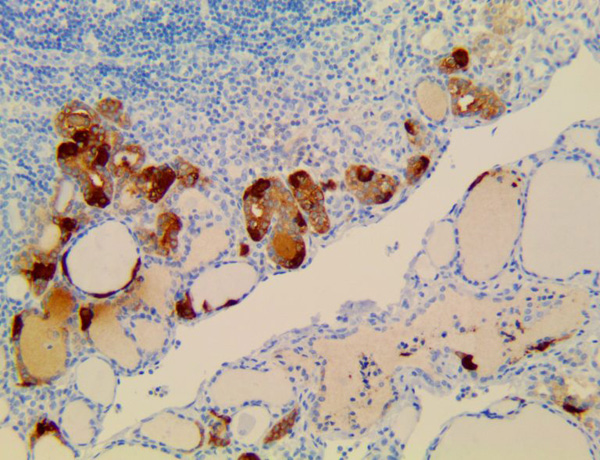
Immunohistochemistry helps locate specific proteins in cells or tissue samples using antibodies.
Flow cytometry looks at and sorts cells. It uses antibodies that are conjugated to reporter molecules called “fluorophores”, which, under special lights, emit light themselves, which can then be measured by a detector instrument.
How Monoclonal Antibodies Are Used as Medicine?
Please note that all of the products listed in AAA Biotech’s catalog are strictly for research-use only (RUO).
Monoclonal antibodies can also be used as therapeutic/medical treatments, particularly in the context of cancers. They are designed to find and bind to specific cells or proteins, helping the immune system recognize and attack the cancer. These treatments work in different ways, such as:
Radioimmunotherapy attaches a small amount of radioactive molecule to the antibody, so it delivers the radiation directly to the cancer cells that the antibody is specifically binding to.
Antibody-directed enzyme prodrug therapy uses antibodies that are specifically bound to special enzymes. These enzymes activate a harmless drug in the body and turn it into a cancer-killing drug only near the cancer cells—this helps avoid harming healthy cells.
Immunoliposomes are tiny “bubbles” filled with medicine/drug and coated with antibodies. They carry the drug straight to the cancer cells.
Why Buy Monoclonal Antibodies From Us?
At AAA Biotech, we provide high-performance monoclonal antibodies designed to support a wide range of research needs.
1. Validated for Versatile Applications
The antibodies in our catalog are extensively validated and compatible with multiple techniques, including (but not limited to) ELISA, flow cytometry (FC), immunocytochemistry (ICC), immunofluorescence (IF), immunohistochemistry (IHC), immunoprecipitation (IP), and western blotting (WB).
2. Wide Selection & Specialized Options
We offer antibodies for common and rare species, that are available in various conjugated forms, and also in recombinant formats. Essentially, there is almost anything one might need to meet their experimental model’s requirements.
3. High-Quality Proteins
Our proteins meet high purity standards—90% or more as confirmed by SDS-PAGE. Many are available with tags like His, Flag, GST, or MBP, and we also supply native and biologically active proteins for functional studies.
Frequently Asked Questions
1. Are your monoclonal antibodies validated for specific applications?
Yes, our antibodies are tested and validated for use in methods such as ELISA, western blot, IHC, flow cytometry, and more. Refer to specific product pages or datasheets for individual product information.
2. How do I choose the right monoclonal antibody for my application?
Review the product details directly for application validation, species reactivity, and target information. You may also contact our support team at any time for help.
3. How quickly can I receive my order?
Most orders are processed and shipped within 1–3 business days, depending on product availability and your shipping location.
Submit a Question
Please complete the form below and a representative will contact you as soon as possible.
Request more Information
Please complete the form below and a representative will contact you as soon as possible.
Request a Manual
Please complete the form below and a representative will contact you as soon as possible.
Request a Quote
Please complete the form below and a representative will contact you as soon as possible.