AAA Biotech provides a variety of high-quality recombinant and natural/native proteins that are proven to work in a wide range of experiments. Explore our products to find the active protein that best fits your needs or experimental model.
Application Data (Active alpha synuclein aggregate seeds the formation of new alpha Synuclein aggregates from the pool of active alpha Synuclein monomers. Thioflavin T is a fluorescent dye that binds to beta sheet-rich structures, such as those in alpha Synuclein aggregates. Upon binding, the emission spectrum of the dye experiences a red-shift, and increased fluorescence intensity. Thioflavin T emission curves show increased fluorescence (correlated to alpha Synuclein protein aggregation) over time when 10 nM of active alpha Synuclein aggregate is combined with 100 uM of active alpha Synuclein monomer, as compared to when 100 uM of active alpha Synuclein monomer is combined with 10 nM of control alpha Synuclein aggregate, or 100 uM of control alpha Synuclein monomer is combined with 10 nM of control alpha Synuclein aggregate. Thioflavin T ex = 450 nm, em = 485 nm.)
Application Data (Primary rat hippocampal neurons show lewy body inclusion formation when treated with active Alpha Synuclein Protein Aggregate at 4 ug/ml (D-F), but not when treated with control Alpha Synuclein Protein Aggregate at 4 ug/ml (A-C). Tissue: Primary hippocampal neurons. Species: Sprague-Dawley rat. Fixation: 4% formaldehyde made from PFA. Primary Antibody: Mouse anti-pSer129 Antibody at 1:1000 24 hours at 4 degree C. Secondary Antibody: FITC Goat Anti-Mouse (green) at 1:700 for 1 hours at RT. Counterstain: Hoechst (blue) nuclear stain at 1:4000 for 1 hour at RT. Localization: Lewy body incluscions. Magnification: 20x.)
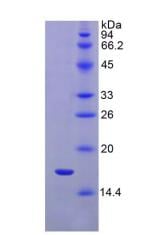
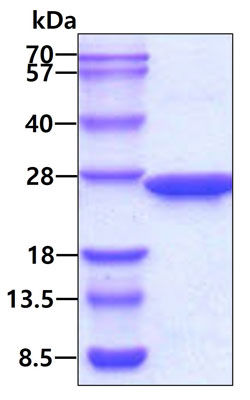
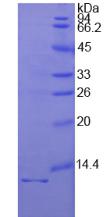
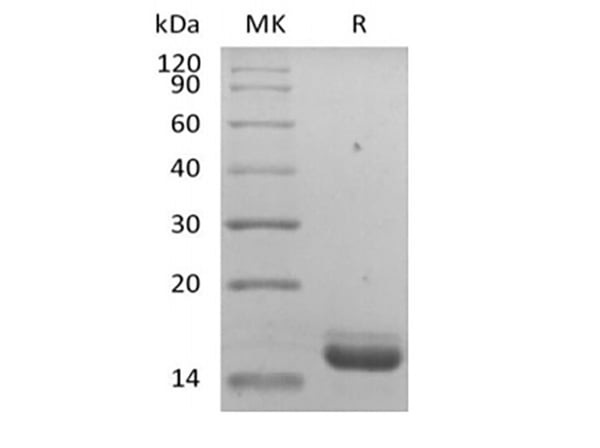
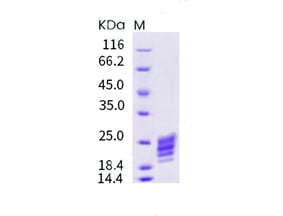
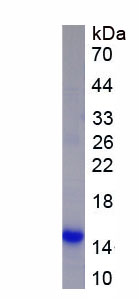
SDS-PAGE (SDS-PAGE of ~14 kDa Human Recombinant Alpha Synuclein Protein Aggregate. Lane 1: Molecular Weight Ladder (MW). Lane 2: Alpha Synuclein Protein Aggregate (SPR-317).)
SDS-PAGE (SDS-PAGE of ~14 kDa Active Human Recombinant Alpha Synuclein Protein Aggregate. Lane 1: Molecular Weight Ladder (MW). Lane 2: Active Alpha Synuclein Protein Aggregate.)
Application Data (Active alpha synuclein aggregate seeds the formation of new alpha Synuclein aggregates from the pool of active alpha Synuclein monomers. Thioflavin T is a fluorescent dye that binds to beta sheet-rich structures, such as those in alpha Synuclein aggregates. Upon binding, the emission spectrum of the dye experiences a red-shift, and increased fluorescence intensity. Thioflavin T emission curves show increased fluorescence (correlated to alpha Synuclein protein aggregation) over time when 10 nM of active alpha Synuclein aggregate is combined with 100 uM of active alpha Synuclein monomer, as compared to active alpha Synuclein aggregate and active alpha Synuclein monomer alone. Thioflavin T ex = 450 nm, em = 485 nm.)
Application Data (Primary rat hippocampal neurons show lewy body inclusion formation when treated with active Alpha Synuclein Protein Aggregate at 4 ug/ml (D-F), but not when treated with control Alpha Synuclein Protein Aggregate at 4 ug/ml (A-C). Tissue: Primary hippocampal neurons. Species: Sprague-Dawley rat. Fixation: 4% formaldehyde from PFA. Primary Antibody: Mouse anti-pSer129 Antibody at 1:1000 24 hours at 4 degree C. Secondary Antibody: FITC Goat Anti-Mouse (green) at 1:700 for 1 hours at RT. Counterstain: Hoechst (blue) nuclear stain at 1:4000 for 1 hour at RT. Localization: Lewy body incluscions. Magnification: 20x.)
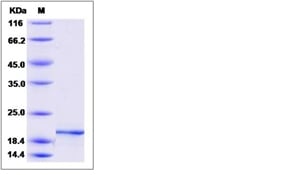
SDS-PAGE (SDS-PAGE of ~14 kDa Active Mouse Recombinant Alpha Synuclein Protein Monomer (SPR-323). Lane 1: Molecular Weight Ladder (MW). Lane 2: Active Alpha Synuclein Protein Monomer (2 ug) (SPR-323).)
Application Data (Active alpha synuclein aggregate (SPR-324) seeds the formation of new alpha Synuclein aggregates from the pool of active alpha Synuclein monomers (SPR-323). Thioflavin T is a fluorescent dye that binds to beta sheet-rich structures, such as those in alpha Synuclein aggregates. Upon binding, the emission spectrum of the dye experiences a red-shift, and increased fluorescence intensity. Thioflavin T emission curves show increased fluorescence (correlated to alpha Synuclein protein aggregation) over time when 10 nM of active alpha Synuclein aggregate (SPR-324) is combined with 100 uM of active alpha Synuclein monomer (SPR-323), as compared to active alpha Synuclein aggregate (SPR-324) and active alpha Synuclein monomer (SPR-323) alone. Thioflavin T ex = 450 nm, em = 485 nm.)
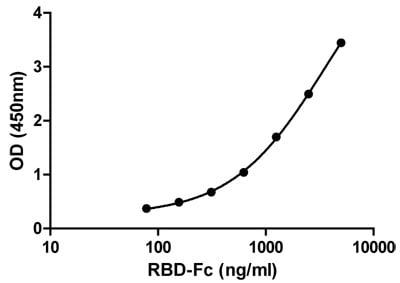
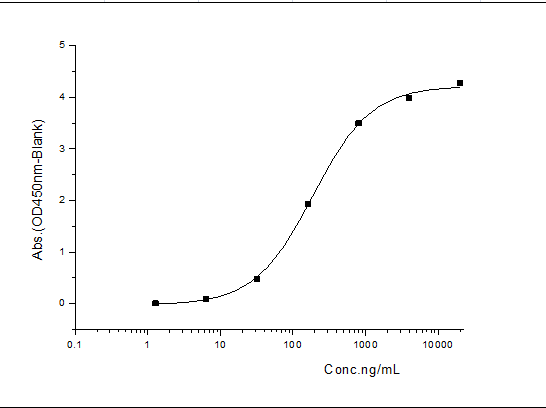
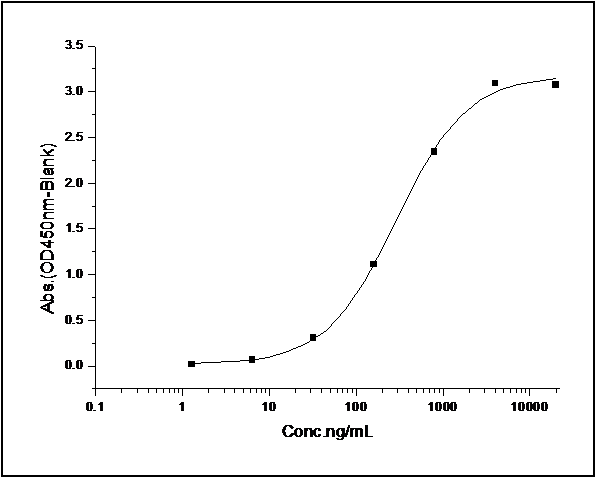
Bioactivity (Measured by its binding ability in a functional ELISA. Immobilized SARS-CoV-2-S1-RBD at 5 ug/ml can bind human ACE2 , the EC50 of SARS-CoV-2-S1-RBD protein is 115.0 - 274.9 ng/ml)
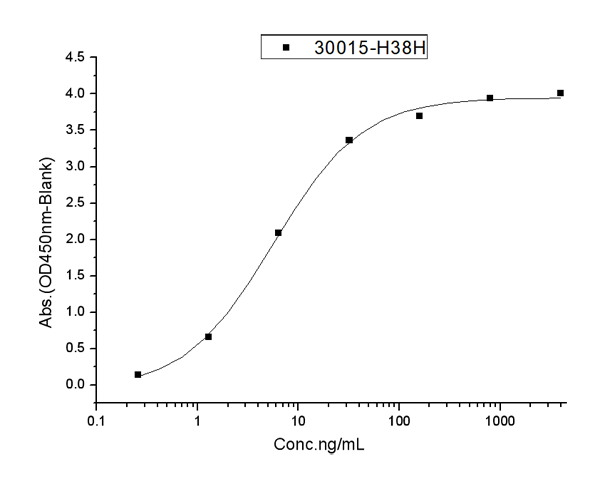
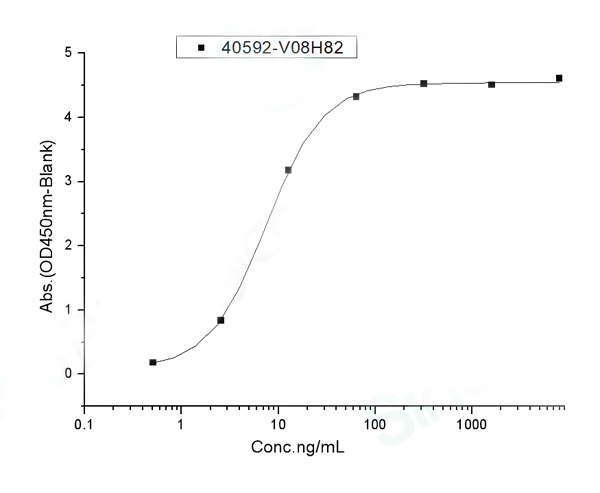
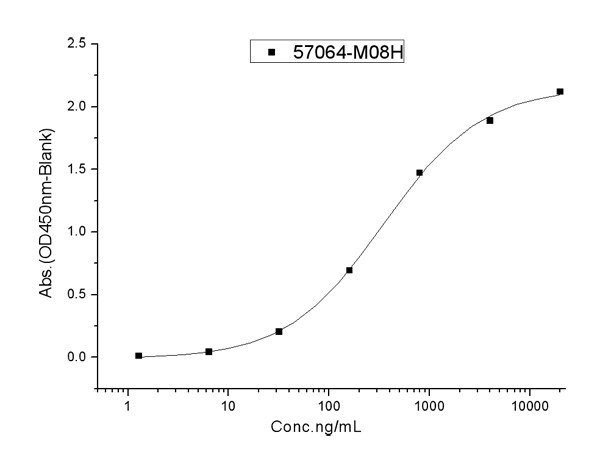
Bioactivity (Measured by its binding ability in a functional ELISA. Immobilized SARS-CoV-2-S1-RBD at 2 ?g/ml can bind SARS-CoV-2-S Antibody , the EC50 of SARS-CoV-2-S1-RBD protein is 13.96 -16.62 ng/ml)
Bioactivity (Measured by its binding ability in a functional ELISA. Immobilized SARS-CoV-2-S1-RBD at 2 ?g/ml can bind SARS-CoV-2-S Antibody , the EC50 of SARS-CoV-2-S1-RBD protein is 27.96 - 33.35 ng/ml.)
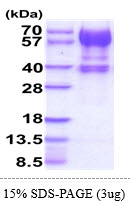
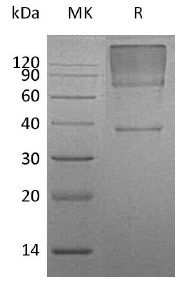
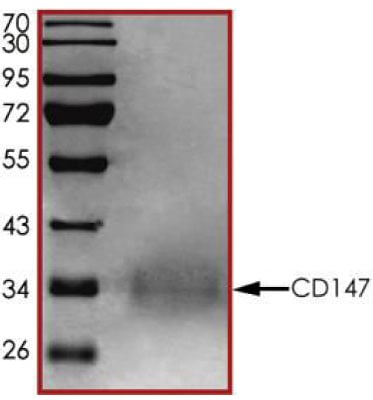
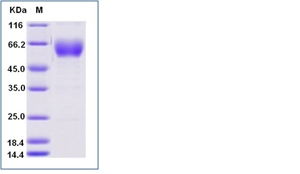
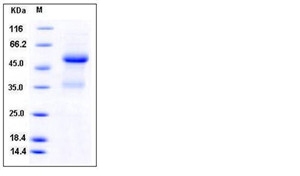
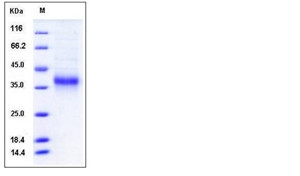
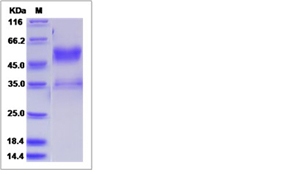
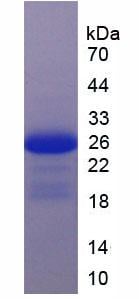
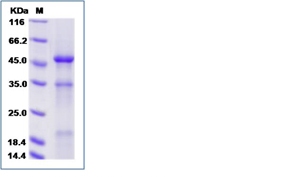
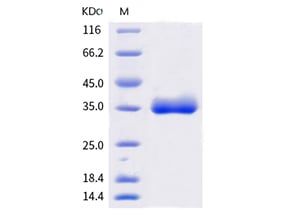
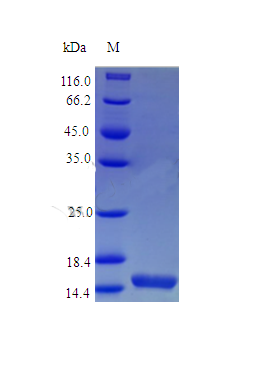
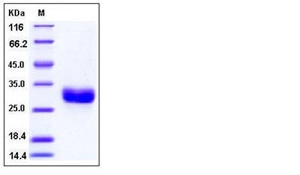
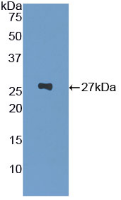
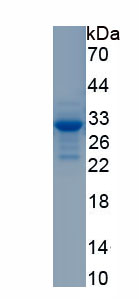
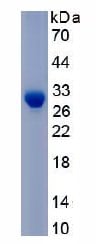
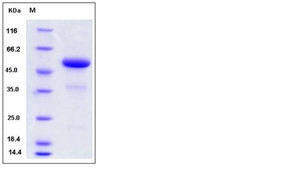
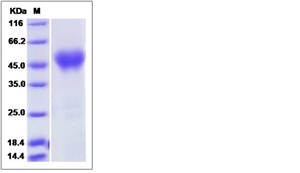
SDS-PAGE ((Tris-Glycine gel) Discontinuous SDS-PAGE (reduced) with 5% enrichment gel and 15% separation gel. Predicted band size: 30.1 kDa Observed band size: 35 kDa due to glycosylation)
Application Data (Measured by its binding ability in a functional ELISA. Immobilized human EphB4-his at 2 ug/ml (100 ul/well) can bind human EphrinB2 Fc chimera with a linear range of 1-25 ng/ml.)
Application Data (Measured by its binding ability in a functional ELISA. Immobilized human EFNB2 at 10ug/mL (100uL/well) can bind biotinylate human EphB4-Fc, the EC50 of biotinylate human EphB4-Fc is 5-60 ng/mL.)
Application Data (Measured by its binding ability in a functional ELISA. Immobilized mouse EphB3 at 2 ug/ml (100 ul/well) can bind human EFNB1 Fc chimera with a linear ranger of 1.56-25 ng/ml.)
Application Data (Measured in a cell proliferation assay using NIH-3T3 mouse embryonic fibroblast cells. The ED50 for this effect is typically 0.1--1 ug/mL in the presence of 2.5 ug/mL of rmKlotho beta.)
Application Data (Measured by its ability to inhibit the biological activity of IGFI or IGFII on MCF7 human breast adenocarcinoma cells (Karey, K.P. et al. (1988) Cancer Research 48:4083.). The ED50 for this effect is typically 0.04-0.4 ug/mL in the presence of 14 ng/mL human IGFII.)
Application Data (Measured in a serum-free cell proliferation assay using MCF-7 human breast cancer cells. Karey, K.P. et al. (1988) Cancer Research 48:4083. The ED50 for this effect is typically 0.01-0.04 ug/mL.)
Application Data (Measured by its binding ability in a functional ELISA. Immobilized human CD7-His at 10 ug/ml (100 ul /well) can bind biotinylated SECTM1-His, The EC50 of biotinylated SECTM1-His is 11-26ng/ml.)
Application Data (Measured by its ability to inhibit NGF-induced proliferation of TF-1 human erythroleukemic cells. The ED50 for this effect is typically 0.2-0.8 ug/ml in the presence of 10 ng/mL of Recombinant human NGF.)
Application Data (Measured by its binding ability in a functional ELISA. Immobilized recombinant human CD200 at 1 ug/ml (100 ul/well) can bind human CD200R1 / Fc Chimera with a linear range of 0.12-16 ng/ml.)
Application Data (Measured by its binding ability in a functional ELISA. Immobilized human EPHA3-His at 10 ug/ml (100 ul/well) can bind human EphrinA5-Fc, The EC50 of human EphrinA5-Fc is 6.2-14.6 ng/ml.)
Application Data (Measured by its binding ability in a functional ELISA. Immobilized human human B7-H2 at 1 ug/ml (100 ul/well) can bind human ICOS with a linear range of 1.6-200 ng/ml.)
Application Data (1. Immobilized Human ERBB3 His at 2 ug/ml (100 ul/well) can bind Human NRG1 Fc, the EC50 of Human NRG1 Fc is 8-40 ng/mL. 2. Immobilized Rhesus ERBB3 His at 2 ug/ml (100 ul/well) can bind Human NRG1 Fc, the EC50 of Human NRG1 Fc is 20-80 ng/mL.)
Application Data (Measured by its binding ability in a functional ELISA. Immobilized human SIRPA-His at 10 ug/ml (100 ul/well) can bind human CD47-Fc, The EC50 of human CD47-Fc is 10.1-23.5 ng/ml.)
Application Data (Measured by its binding ability in a functional ELISA. Immobilized human SIRPG-His at 10 ug/ml (100 ul/well) can bind human CD47-Fc, The EC50 of human CD47-Fc is 0.58-1.34 ug/ml.)
Application Data (Measured by its binding ability in a functional ELISA. Immobilized human EPHB1-His at 10 ug/ml (100 ul/well) can bind human EFNB2-Fch with a linear ranger of 0.3125-20 ng/mL.)
Application Data (Measured by its binding ability in a functional ELISA. Immobilized human EPHB1-His at 10 ug/ml (100 ul/well) can bind human EFNB1-Fc2h with a linear ranger of 3.125-200 ng/mL.)
Application Data (Measured by its binding ability in a functional ELISA. Immobilized human CADM1 at 2 ug/ml (100 ul/well) can bind biotinylated human CRTAM with a linear range of 12.5-400 ng/ml.)
Application Data (Using the Octet RED System, the affinity constant (Kd) of CD32B / Fcgr2b Protein, Human, Recombinant (His Tag) bound to Conbercept was 0.3 nM.)
Application Data (Measured by its binding ability in a functional ELISA. Immobilized human sCD32b-His (CHO) at 10 ug/ml (100 ul/well) can bind biotinylated human IgG1, The EC50 of biotinylated human IgG1 is 0.18-0.42 ug/ml.)
Application Data (Measured in a cell proliferation assay using BaF3 mouse pro-B cells transfected with mouse Flt-3. The ED50 for this effect is typically 2-11 ng/mL.)
Application Data (Measured by its binding ability in a functional ELISA. Immobilized human GFRA1-Fc at 10 ug/mL (100 uL/well) can bind GDNF/Biotin, the EC50 of human GDNF/Biotin is 20-50 ng/mL.)
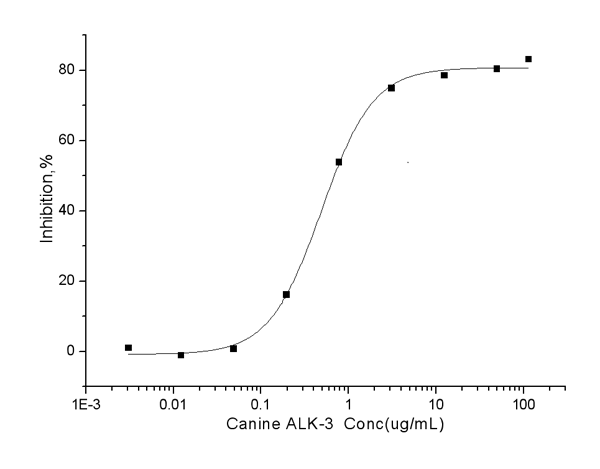
Application Data (Measured by its ability to inhibit rhIFN-gamma mediated protection of WISH cells infected with vesicular stomatitis virus(VSV). The ED50 for this effect is typically 2-8 ug/mL.)
Application Data (Measured by its binding ability in a functional ELISA. Immobilized human human B7-H2 at 1 ug/ml (100 ul/well) can bind human ICOS with a linear range of 1.6-200 ng/ml.)
Application Data (Measured by its binding ability in a functional ELISA. Immobilized TGFBR2h (1-166Q) at 10 ug/mL (100 uL/well) can bind TGFB1-His/Biotin, the EC50 of human TGFB1-His/Biotin is 130-300 ng/mL.)
Application Data (Measured by its binding ability in a functional ELISA. Immobilized PPICZa-IFNA2 at 10 ug/mL (100 uL/well) can bind IFNaR2-Fc, the EC50 of IFNaR2-Fc is 60-200 ng/mL.)
Application Data (Measured by its ability to induce alkaline phosphatase production by C3H10T1/2 mouse embryonic fibroblast cells. Nakamura, T. et al. (1997) Biochem. Biophys. Res. Commun.237:465. The ED50 for this effect is typically 2-10 ug/mL.)
Application Data (Measured by its ability to inhibit TNF-alpha mediated cytotoxicity in L-929 mouse fibrosarcoma cells in the presence of the metabolic inhibitor actinomycin D. The ED50 for this effect is typically 5-40 ng/mL in the presence of 1 ng/mL recombinant human TNF-alpha.)
Application Data (Measured by its binding ability in a functional ELISA. Immobilized PDGFRbeta-His at 10 ug/ml (100 ul/well) can bind Cynomolgus PDGFB, The EC50 of Cynomolgus PDGFB is 3-8 ng/ml.)
Application Data (Measured by its binding ability in a functional ELISA. Immobilized human BMPR-II-Fc at 10 ug/mL (100 ul/well) can bind biotinylated human BMP2-Fc, The EC50 of biotinylated human BMP2-Fc is 80-110 ng/mL.)
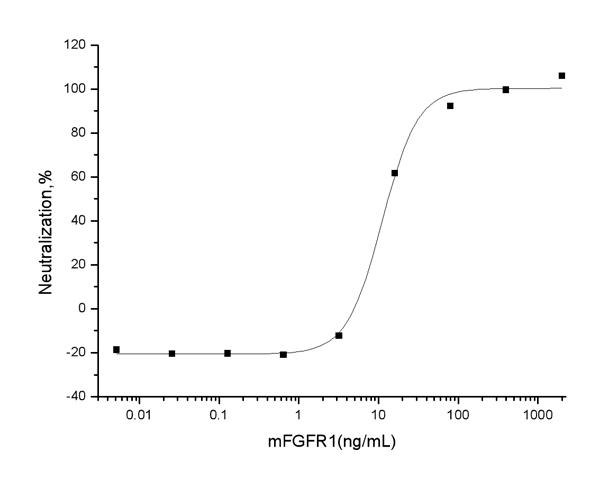
Application Data (Measured in a cell proliferation assay using BaF3 mouse pro-B cells transfected with human FGFR2b. The EC50 for this effect is typically 2-14 ng/mL.)
Application Data (Measured by its binding ability in a functional ELISA. Immobilized Human IGF1 at 2 ug/ml (100 ul/well) can bind Human IGFBP4 His, the EC50 of Human IGFBP4 His is 10-60 ng/mL.)
Application Data (Measured in a cytotoxicity assay using L929 mouse fibrosarcoma cells in the presence of the metabolic inhibitor actinomycin D. The ED50 for this effect is typically 1-5 ng/mL.)
Application Data (Measured by its ability to neutralize Activin-mediated inhibition on MPC11 cell proliferation. The ED50 for this effect is typically 0.5-3 ug/mL in the presence of 10 ng/ml Recombinant Human ctivin A.)
Application Data (Measured by its binding ability in a functional ELISA. Immobilized recombinant human Angiopoietin-2 at 10 ug/ml (100 ul/well) can bind Human Tie2 / Fc chimera with a range of 0.2-20 ug/ml.)
Application Data (Measured by its binding ability in a functional ELISA. Immobilized EPOR (hFc Tag) at 2 ug/mL (100uL/well) can bind Cynomolgus Erythropoietin-His, the EC50 of Cynomolgus Erythropoietin-His is 4-20 ng/mL.)
Application Data (Measured by its binding ability in a functional ELISA. Immobilized human CD40L-His at 10 ug/mL (100 uL/well) can bind Human CD40-Fc. The EC50 of Human CD40-Fc is 10-30 ng/mL.)
Application Data (Measured by its binding ability in a functional ELISA. Immobilized human CD70 at 10 ug/mL (100 ul/well) can bind human CD27 with a linear range of 40-60 ng/ml.)
Application Data (Measured by its binding ability in a functional ELISA. Immobilized human CD70 at 10 ug/mL (100 ul/well) can bind mouse CD27 with a linear range of 70-90 ng/ml.)
Application Data (Measured by its binding ability in a functional ELISA. Immobilized Human CD27 His at 2 ug/ml (100 ul/well) can bind Human CD70 hFc, the EC50 of Human CD70 hFc is 15-60 ng/mL.)
Proteins are large molecules made up of long chains of amino acids.
They will typically fold into a very particular 3-dimensional shape/conformation, that is sometimes referred to as their “native” form, which allows them to work properly in the body. For the purposes of product categorization, AAA Biotech will typically refer to proteins purified from their original animal host as being “native” proteins (this is to signify their difference compared to their “recombinant” or “synthetic” protein counterparts).
If a protein successfully folds into the correct shape, it is will typically display high fidelity characteristics to its original protein in its original animal host, and be classified as an active protein, as it will be able to function “normally” in most enzymatic or binding capacities. If it loses this shape, due to factors such as heat or strong chemicals (such as detergents), it becomes inactive and is no longer able to perform its basic functions. All of the proteins in this category are made under strict quality control, and they are active, pure, low in contaminants, and stable.
Most are stored as freeze-dried powders and come without extra tags, so they’re very close to the actual natural/native form.
Key Applications of Active Proteins
1. Scientific Research
Aid in the study of how proteins function in the body
Aid in understanding various disease processes
2. Drug Development
Powerful tools to investigate how potential drugs interact with specific proteins
Ideal for identifying drug targets
3. Cell Culture
Are routinely utilized to support cell growth and function (e.g., using exogenous growth factors)
Can be used to promote cellular development into specific types (differentiation)
4. Diagnostics
Regularly utilized in tests to detect diseases or infections (e.g., COVID-19, cancer)
Note: All products are strictly for research-use only (RUO).
5. Therapeutics
Some active proteins are used directly as treatments (e.g., insulin, enzymes)
Note: All products are strictly for research-use only (RUO).
6. Vaccine Development
Used to create or test vaccines by mimicking parts of viruses or bacteria
7. Biochemical Assays
They can facilitate the characterization of enzyme activity, binding strength, or protein interactions in lab tests
Why Buy Active Proteins from AAA Biotech?
High biological activity – Verified to perform as expected or indicated on datasheet
Strict quality control – We are confident in our active proteins’ reliability and consistency
High purity & low endotoxin – Ideal for applications involving sensitive or precious samples/components
Freeze-dried for stability – Long shelf life and straightforward storage
Mostly tag-free – Closer to natural/native protein form
FAQ
1. What are active proteins used for in research?
Active proteins are used primarily in the study of how proteins function, in characterizing/discovering drug interactions, supporting cell growth, running biochemical assays, and in development of diagnostics or therapeutics.
2. How are AAA Biotech's active proteins validated?
AAA Biotech’s active proteins are validated through strict quality control and functional assays to ensure they are properly folded and active. “Active”, though, can be an ambiguous term, so if a specific “activity” or “binding” capability of a protein is of crucial interest to you, please inquire with us prior to purchase, and we will provide further details on how the “Active” modifier was determined to be applicable.
3. Are these proteins tested for biological activity?
Yes, all active proteins from AAA Biotech are tested to confirm they have the expected biological activity before being offered for use. Though, said “biological activity” can be either “enzymatic”, “binding”, or both.
Submit a Question
Please complete the form below and a representative will contact you as soon as possible.
Request more Information
Please complete the form below and a representative will contact you as soon as possible.
Request a Manual
Please complete the form below and a representative will contact you as soon as possible.
Request a Quote
Please complete the form below and a representative will contact you as soon as possible.