
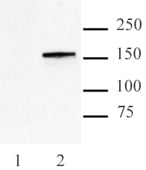
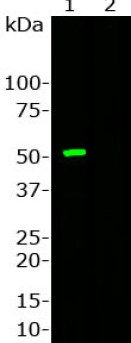
 WB (Western Blot)
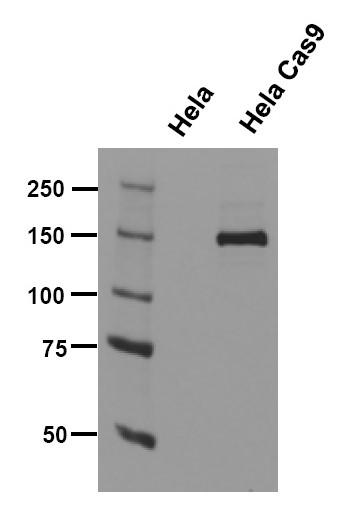
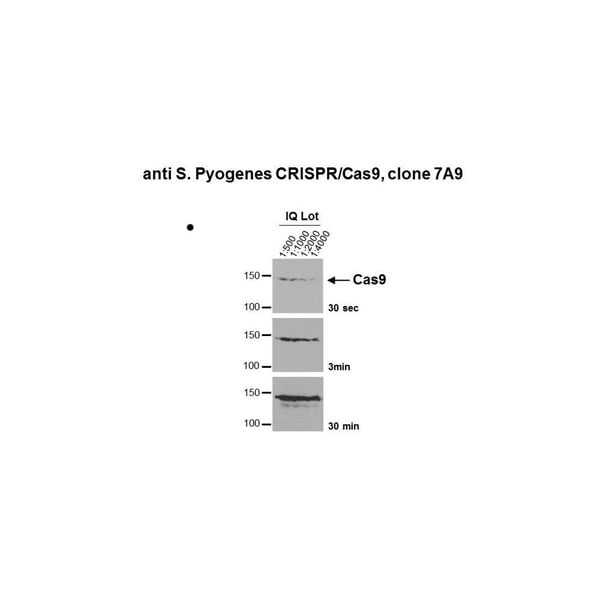
(Cas9 antibody (mAb) tested by Western blot. Hela cells and Hela cells expressing DYKDDDDK-Tagged S.pyogenes Cas9 under the control of the PTight (Tet-ON) promoter were treated for 24h with 1 ?g/?l Doxycyclin and lysed under native conditions. ~30 ?g of whole cell lysate per lane was separated by 7.5% SDS-PAGE, transfered to nitrocellulose membrane and incubated with crude hybridoma supernatant (diluted 1:100) of Cas9 specific monoclonal antibody, 8C1-F10. All incubations were done at 4 degree C o/n.)
WB (Western Blot)
(Cas9 antibody (mAb) tested by Western blot. Hela cells and Hela cells expressing DYKDDDDK-Tagged S.pyogenes Cas9 under the control of the PTight (Tet-ON) promoter were treated for 24h with 1 ?g/?l Doxycyclin and lysed under native conditions. ~30 ?g of whole cell lysate per lane was separated by 7.5% SDS-PAGE, transfered to nitrocellulose membrane and incubated with crude hybridoma supernatant (diluted 1:100) of Cas9 specific monoclonal antibody, 8C1-F10. All incubations were done at 4 degree C o/n.)
Cas9 (Cas9) Antibody – Mouse Monoclonal
Cas9 antibody (mAb)(Clone 8C1-F10)
Product Overview
WB (Western Blot)
(Cas9 antibody (mAb) tested by Western blot. Hela cells and Hela cells expressing DYKDDDDK-Tagged S.pyogenes Cas9 under the control of the PTight (Tet-ON) promoter were treated for 24h with 1 ?g/?l Doxycyclin and lysed under native conditions. ~30 ?g of whole cell lysate per lane was separated by 7.5% SDS-PAGE, transfered to nitrocellulose membrane and incubated with crude hybridoma supernatant (diluted 1:100) of Cas9 specific monoclonal antibody, 8C1-F10. All incubations were done at 4 degree C o/n.)
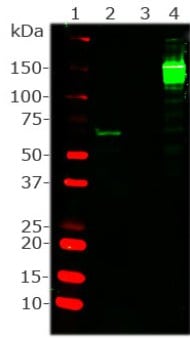
WB (Western Blot)
(Cas9 antibody (mAb) tested by Western blot. Hela cells and Hela cells expressing DYKDDDDK-Tagged S.pyogenes Cas9 under the control of the PTight (Tet-ON) promoter were treated for 24h with 1 ?g/?l Doxycyclin and lysed under native conditions. ~30 ?g of whole cell lysate per lane was separated by 7.5% SDS-PAGE, transfered to nitrocellulose membrane and incubated with crude hybridoma supernatant (diluted 1:100) of Cas9 specific monoclonal antibody, 8C1-F10. All incubations were done at 4 degree C o/n.)
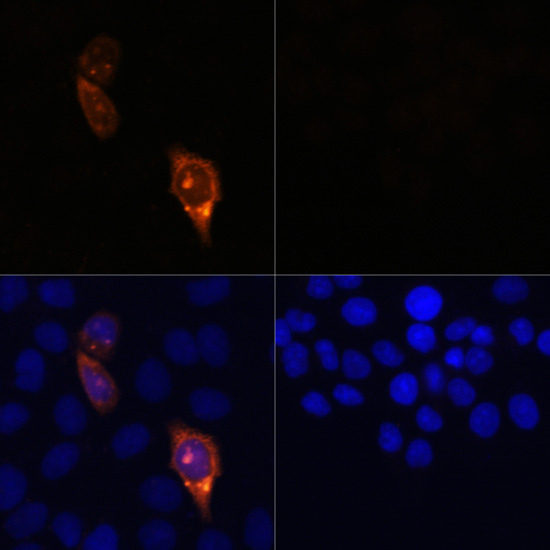
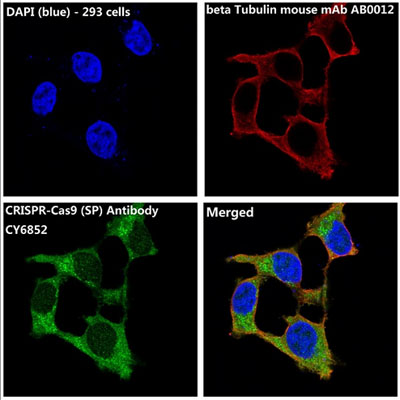
IF (Immunofluorescence)
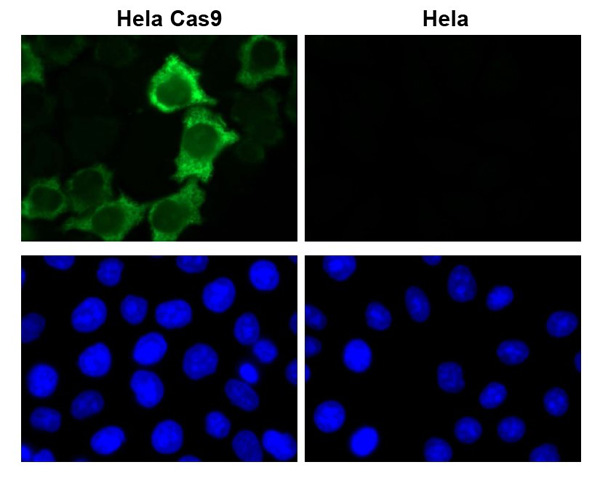
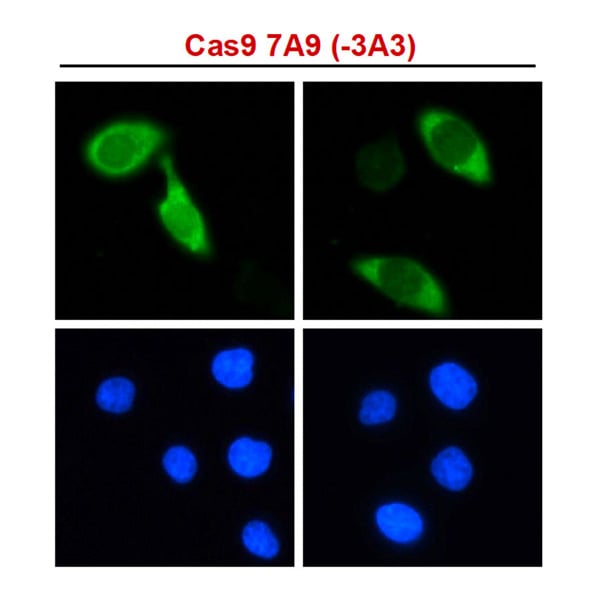
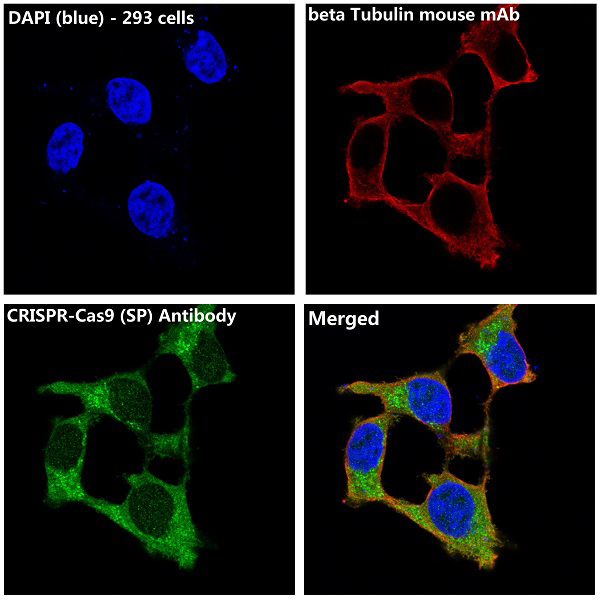
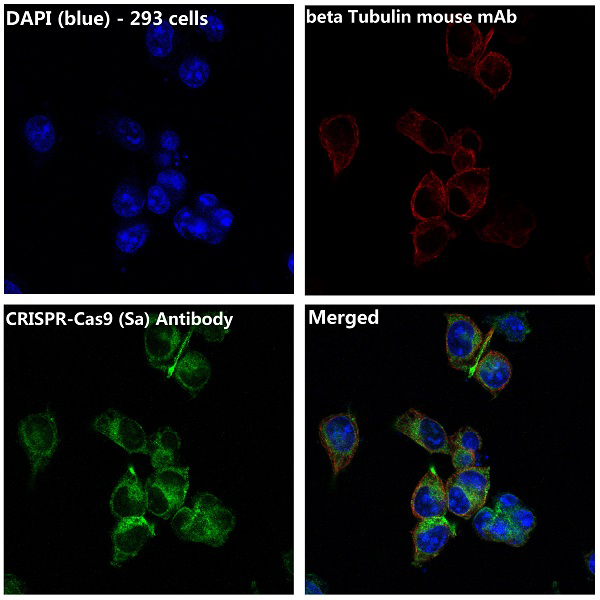
(Cas9 antibody (mAb) tested by Immunofluorescence. Hela cells or Hela cells expressing DYKDDDDK-Tagged Cas9 under the control of the PTight (Tet-ON) promoter were treated for 24h with 1 ?g/?l Doxycyclin, fixed and permeabilized with Methanol/Acetone and blocked in 2% BSA in PBS for 2 hours at RT. Cells were stained with 8C1-F10 hybridoma supernatant diluted 1:10 at 4 degree C o/n, followed by incubation with anti mouse-AF488 coupled secondary antibody for 1 h at RT. Nuclei were counter-stained with Hoechst 33342.)
IF (Immunofluorescence)
(Cas9 antibody (mAb) tested by Immunofluorescence. Hela cells or Hela cells expressing DYKDDDDK-Tagged Cas9 under the control of the PTight (Tet-ON) promoter were treated for 24h with 1 ?g/?l Doxycyclin, fixed and permeabilized with Methanol/Acetone and blocked in 2% BSA in PBS for 2 hours at RT. Cells were stained with 8C1-F10 hybridoma supernatant diluted 1:10 at 4 degree C o/n, followed by incubation with anti mouse-AF488 coupled secondary antibody for 1 h at RT. Nuclei were counter-stained with Hoechst 33342.)
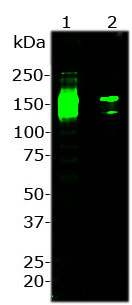
IP (Immunoprecipitation)
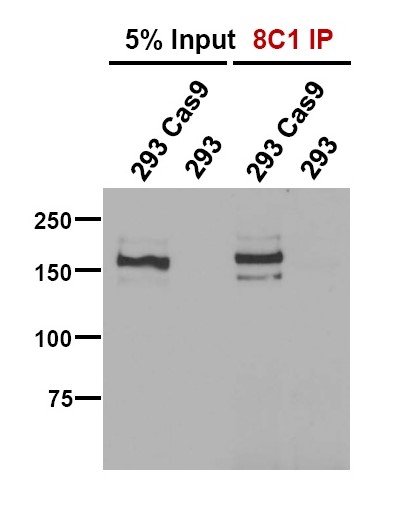
(Cas9 antibody (mAb) tested by Immunoprecipitation. HEK293 cells or HEK293 cells expressing DYKDDDDK-Cas9 were lysed under native conditions. Cas9 was immunoprecipitated at 4 degree C from ~300?g of whole cell lysate with Cas9 clone 8C1-F10 and a 1:1 mixture of protein A and protein G sepharose. After 4x washing, the bound proteins were boiled off the beads, separated by 7.5% SDS-PAGE and transfered to nitrocellulose membranes.)
IP (Immunoprecipitation)
(Cas9 antibody (mAb) tested by Immunoprecipitation. HEK293 cells or HEK293 cells expressing DYKDDDDK-Cas9 were lysed under native conditions. Cas9 was immunoprecipitated at 4 degree C from ~300?g of whole cell lysate with Cas9 clone 8C1-F10 and a 1:1 mixture of protein A and protein G sepharose. After 4x washing, the bound proteins were boiled off the beads, separated by 7.5% SDS-PAGE and transfered to nitrocellulose membranes.)
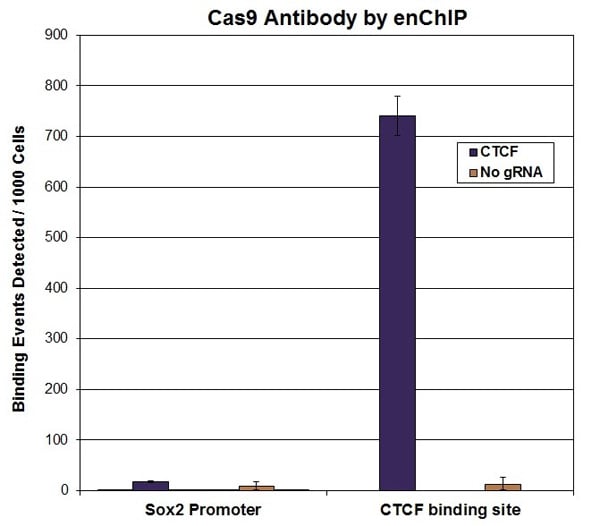
ChIP (Chromatin Immunoprecipitation)
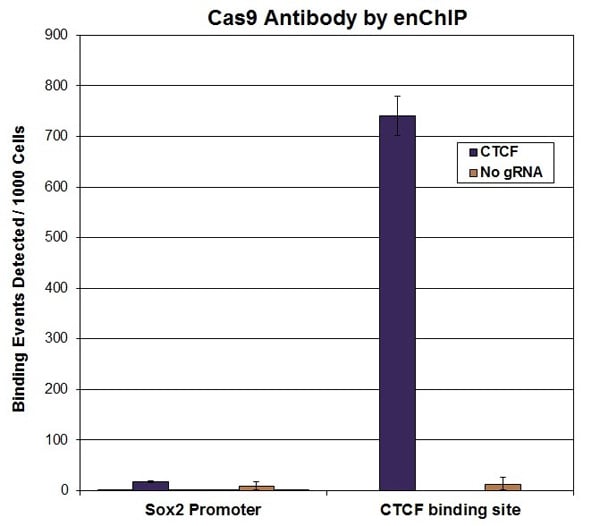
(Cas9 antibody (mAb) tested by enChIP HEK293T cells transfected with vectors encoding both AM-tagged dCas9 and a gRNA targeting a CTCF binding site, or just AM-tagged dCas9 (No gRNA control) were analyzed by enChIP using Cas9 mAb clone 8C1-F10 in place of the AM-tag antibody. DNA eluted from enChIP was subjected to qPCR analysis using primers against the CTCF binding targeted by the enChIP gRNA and the Sox2 promoter (negative control site).)
ChIP (Chromatin Immunoprecipitation)
(Cas9 antibody (mAb) tested by enChIP HEK293T cells transfected with vectors encoding both AM-tagged dCas9 and a gRNA targeting a CTCF binding site, or just AM-tagged dCas9 (No gRNA control) were analyzed by enChIP using Cas9 mAb clone 8C1-F10 in place of the AM-tag antibody. DNA eluted from enChIP was subjected to qPCR analysis using primers against the CTCF binding targeted by the enChIP gRNA and the Sox2 promoter (negative control site).)
ChIP (Chromatin Immunoprecipitation)
(Cas9 antibody (mAb) tested by ChIP. NIH3T3 cells stably expressing GFP-H2B, nuclease dead Cas9, and a GFP-targeting gRNA were fixed with formaldehyde, harvested and sonicated to get 200-500bp DNA fragments. 50?g chromatin was incubated O/N at 4 degree C with Cas9 antibody (200?l hybridoma SN, 5?g a-DYKDDDDK) followed by incubation with protein G beads for 3h at 4 degree C. After washing chromatin was eluted from the beads and crosslinking was reversed )/N at 65 degree C. After a proteinase K digesting step DNA was separated using phenol/chloroform/isoamyl alcohol, precipitated with ethanol/sodium acetate and dissolved in water. For the qPCR primers either targeting the GFP gene or as negative control non-targeted regions (Ppap2c +7122 and Prkcd +24069 from transcription start) were used.)
ChIP (Chromatin Immunoprecipitation)
(Cas9 antibody (mAb) tested by ChIP. NIH3T3 cells stably expressing GFP-H2B, nuclease dead Cas9, and a GFP-targeting gRNA were fixed with formaldehyde, harvested and sonicated to get 200-500bp DNA fragments. 50?g chromatin was incubated O/N at 4 degree C with Cas9 antibody (200?l hybridoma SN, 5?g a-DYKDDDDK) followed by incubation with protein G beads for 3h at 4 degree C. After washing chromatin was eluted from the beads and crosslinking was reversed )/N at 65 degree C. After a proteinase K digesting step DNA was separated using phenol/chloroform/isoamyl alcohol, precipitated with ethanol/sodium acetate and dissolved in water. For the qPCR primers either targeting the GFP gene or as negative control non-targeted regions (Ppap2c +7122 and Prkcd +24069 from transcription start) were used.)
Background: Cas9 is a nuclease from Streptococcus pyogenes that can be targeted to particular DNA sequences through a guide RNA that results in double-stranded breaks in DNA. Cas9 is part of the CRISPR/Cas9 gene-editing system that can create a DNA break at a specific location with the genome. CRISPR (clustered regularly interspaced short palindromic repeat) is an adaptive immune system that provides protection against mobile genetic elements (viruses, transposable elements and conjugative plasmids). CRISPR clusters contain spacers, sequences complementary to antecedent mobile elements, and target invading nucleic acids. CRISPR clusters are transcribed and processed into CRISPR RNA (crRNA) Probable. In type II CRISPR systems correct processing of pre-crRNA requires a trans-encoded small RNA (tracrRNA), endogenous ribonuclease 3 (rnc) and this protein. The tracrRNA serves as a guide for ribonuclease 3-aided processing of pre-crRNA. Subsequently Cas9/crRNA/tracrRNA endonucleolytically cleaves linear or circular dsDNA target complementary to the spacer. The target strand not complementary to crRNA is first cut endonucleolytically, then trimmed by 3'-5' exonucleolytically. DNA-binding requires protein and both RNA species. Cas9 probably recognizes a short motif in the CRISPR repeat sequences (the PAM or protospacer adjacent motif) to help distinguish self versus nonself.
NCBI and Uniprot Product Information
Customer Reviews
Loading reviews...
Share Your Experience
Similar Products


Additional Details
Product Notes
The Cas9 (Catalog #AAA60083) is an Antibody produced from Mouse and is intended for research purposes only. The product is available for immediate purchase. The Cas9 antibody (mAb)(Clone 8C1-F10) reacts with Human, Mouse and may cross-react with other species as described in the data sheet. AAA Biotech's Cas9 can be used in a range of immunoassay formats including, but not limited to, WB (Western Blot), IP (Immunoprecipitation), IF (Immunofluorescence), ChIP (Chromatin immunoprecipitation). Researchers should empirically determine the suitability of the Cas9 for an application not listed in the data sheet. Researchers commonly develop new applications and it is an integral, important part of the investigative research process. It is sometimes possible for the material contained within the vial of "Cas9, Monoclonal Antibody" to become dispersed throughout the inside of the vial, particularly around the seal of said vial, during shipment and storage. We always suggest centrifuging these vials to consolidate all of the liquid away from the lid and to the bottom of the vial prior to opening. Please be advised that certain products may require dry ice for shipping and that, if this is the case, an additional dry ice fee may also be required.Precautions
All products in the AAA Biotech catalog are strictly for research-use only, and are absolutely not suitable for use in any sort of medical, therapeutic, prophylactic, in-vivo, or diagnostic capacity. By purchasing a product from AAA Biotech, you are explicitly certifying that said products will be properly tested and used in line with industry standard. AAA Biotech and its authorized distribution partners reserve the right to refuse to fulfill any order if we have any indication that a purchaser may be intending to use a product outside of our accepted criteria.Disclaimer
Though we do strive to guarantee the information represented in this datasheet, AAA Biotech cannot be held responsible for any oversights or imprecisions. AAA Biotech reserves the right to adjust any aspect of this datasheet at any time and without notice. It is the responsibility of the customer to inform AAA Biotech of any product performance issues observed or experienced within 30 days of receipt of said product. To see additional details on this or any of our other policies, please see our Terms & Conditions page.Item has been added to Shopping Cart
If you are ready to order, navigate to Shopping Cart and get ready to checkout.