
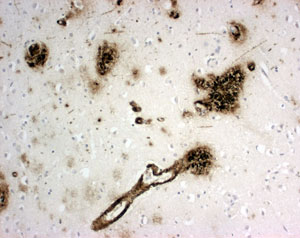
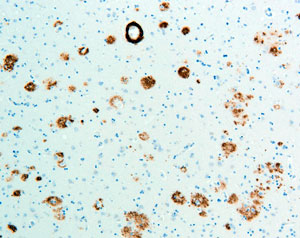
 IHC (Immunohiostchemistry)
Mouse anti-Human Amyloid-beta Monoclonal Antibody
Amyloid-beta (N-term), Human, mAb VU17
Reactivity
Human
Applications
Immunoprecipitation, Immunohistochemistry
Synonyms
Amyloid-beta, Antibody; Amyloid-beta (N-term), Human, mAb VU17; Abeta; beta-Amyloid; anti-Amyloid-beta antibody
Host
Mouse
Reactivity
Human
Clonality
Monoclonal
Isotype
IgG2a
Clone Number
VU17
Form/Format
1 ml (100 ug/ml) 0.2 um filtered antibody solution in PBS, containing 0.1% bovine serum albumin and 0.02% sodium azide.
For unit size 0.5 mg or larger: PBS only (concentration< 0.5mg/ml)
For unit size 0.5 mg or larger: PBS only (concentration< 0.5mg/ml)
Applicable Applications for anti-Amyloid-beta antibody
IP (Immunoprecipitation), IA (Immunoassay), IHC (Immunohistochemistry)
Preparation and Storage
Store at 4 degree C. Under recommended storage conditions, product is stable for at least one year.
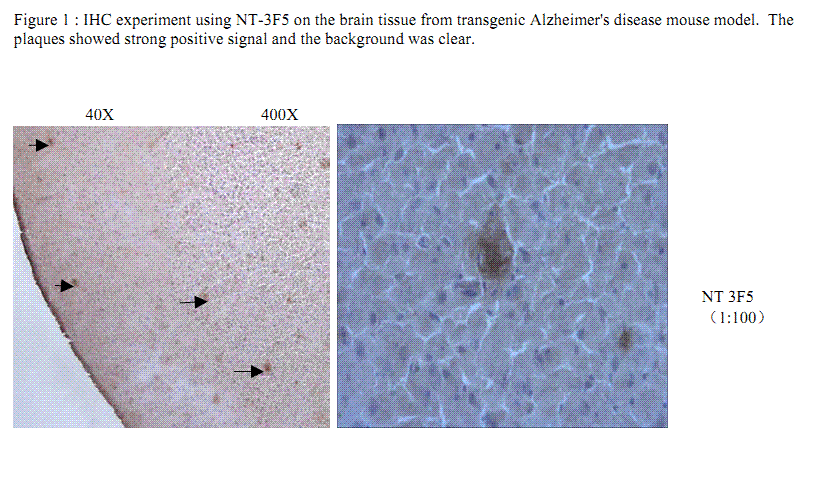
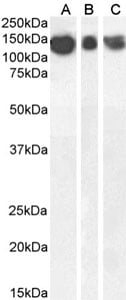
IHC (Immunohiostchemistry)
IHC (Immunohiostchemistry)
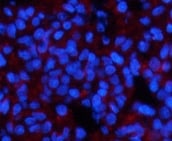
IHC (Immunohistochemistry)
IHC (Immunohistochemistry)
Related Product Information for anti-Amyloid-beta antibody
Antibody clone VU17, formerly known as alphaVU Abeta 17, recognizes the N-terminus of human amyloid beta (i.e. in: Abeta1-38; Abeta1-39; Abeta1-40; Abeta1-42). Amyloid beta peptides are of key importance in the development of Alzheimer's disease (AD) and are present in CSF. AD affects approximately 1% of the population over the age of 80. The disease is characterized by aggregation of Abeta into oligomers, fibrils and plaques deposition of insoluble and aggregated protein in the brain where its neurotoxic action leads to neuronal cell death. The deposits, also called amyloid plaques, are formed around the neuropil. The exact molecular mechanism is still unclear. Abeta is a proteolytic cleavage product, by APP-cleaving enzyme 1 (BACE1) and beta-secretase complex, of membrane bound amyloid precursor protein (APP). Amyloid is the term used for proteins that are misfolded into a cross beta-sheet structure. Abeta is produced by various cell types and is secreted in the interstitial fluid. There are multiple cleavage sites in Abeta domain leading to various fragments of 36-43 amino acids in length. The main peptide in the CSF terminate at residue 40. CSF contains many Abeta isoforms, of which Abeta40 is approximately 10 times more abundant than Abeta42. Abeta40 levels are unchanged in AD, but there is a change in Ab40:Abeta42 ratio in AD. This ratio has been thought of importance. Assessment of Abeta in brain tissue is essential for identification and is crucial for investigating the molecular mechanisms underlying AD. Antibody VU17 is raised against the N-terminus of Abeta. The antibody detects all forms of Abeta deposits without the need for formic acid pre-treatment on paraffin coupes and can be applied in a double staining strategy, making it suitable for investigating co-localization.
References
1. Verwey, N et al; Immunohistochemical characterization of novel monoclonal antibodies against the N-terminus of amyloid beta-peptide. Amyloid 2013, 20:3 2. Verwey, N et al; Quantification of amyloid beta 40 in cerebrospinal fluid. Journal of Immunology methods 2009, 348:1-2
Customer Reviews
Loading reviews...
Share Your Experience
Similar Products



Product Notes
The Amyloid-beta (Catalog #AAA77809) is an Antibody produced from Mouse and is intended for research purposes only. The product is available for immediate purchase. The Amyloid-beta (N-term), Human, mAb VU17 reacts with Human and may cross-react with other species as described in the data sheet. AAA Biotech's Amyloid-beta can be used in a range of immunoassay formats including, but not limited to, IP (Immunoprecipitation), IA (Immunoassay), IHC (Immunohistochemistry). Researchers should empirically determine the suitability of the Amyloid-beta for an application not listed in the data sheet. Researchers commonly develop new applications and it is an integral, important part of the investigative research process. It is sometimes possible for the material contained within the vial of "Amyloid-beta, Monoclonal Antibody" to become dispersed throughout the inside of the vial, particularly around the seal of said vial, during shipment and storage. We always suggest centrifuging these vials to consolidate all of the liquid away from the lid and to the bottom of the vial prior to opening. Please be advised that certain products may require dry ice for shipping and that, if this is the case, an additional dry ice fee may also be required.Precautions
All products in the AAA Biotech catalog are strictly for research-use only, and are absolutely not suitable for use in any sort of medical, therapeutic, prophylactic, in-vivo, or diagnostic capacity. By purchasing a product from AAA Biotech, you are explicitly certifying that said products will be properly tested and used in line with industry standard. AAA Biotech and its authorized distribution partners reserve the right to refuse to fulfill any order if we have any indication that a purchaser may be intending to use a product outside of our accepted criteria.Disclaimer
Though we do strive to guarantee the information represented in this datasheet, AAA Biotech cannot be held responsible for any oversights or imprecisions. AAA Biotech reserves the right to adjust any aspect of this datasheet at any time and without notice. It is the responsibility of the customer to inform AAA Biotech of any product performance issues observed or experienced within 30 days of receipt of said product. To see additional details on this or any of our other policies, please see our Terms & Conditions page.Item has been added to Shopping Cart
If you are ready to order, navigate to Shopping Cart and get ready to checkout.